
Applied Mathematics (241) Sample Question Paper 2026-27: Fully Solved
Official CBSE paper · 38 questions · Theory 80 marks · 3 hours
Note
Questions and answers below are extracted from the official CBSE PDFs published on cbseacademic.nic.in. Plain-text extraction may lose mathematical layout, tables or diagrams; consult the original pages linked beside each question. Source discrepancies are identified separately.
Tip
Use the original question and marking pages beside each answer to check fractions, powers, matrices and graphs.
Marks shown per question follow the paper's general instructions and add up to 80.
- Question 11 mark
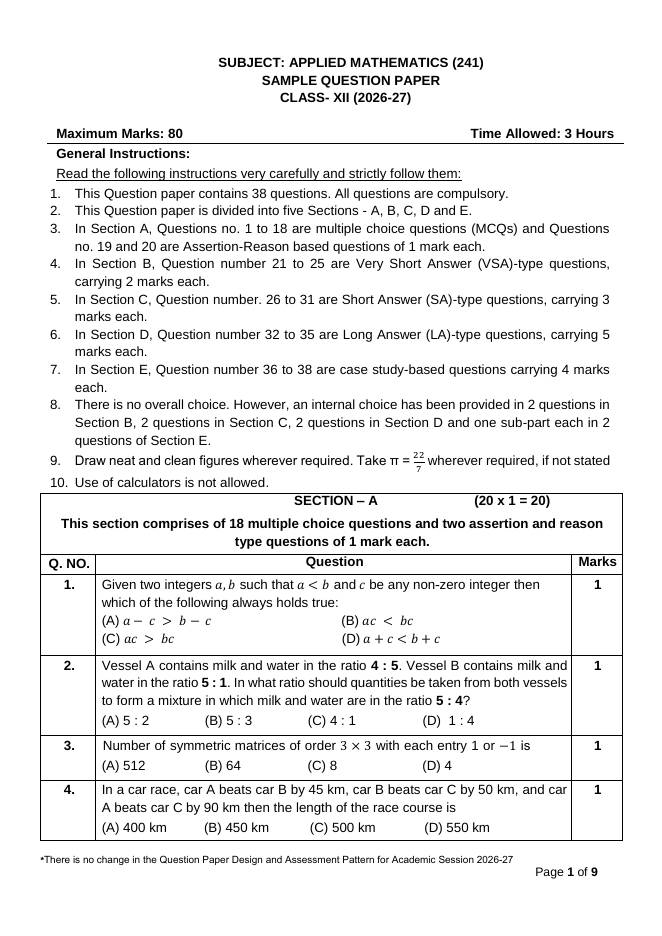
1.    Given two integers 𝑎, 𝑏 such that 𝑎 < 𝑏 and 𝑐 be any non-zero integer then                           1
            which of the following always holds true:
            (A) 𝑎 − 𝑐 > 𝑏 − 𝑐                         (B) 𝑎𝑐 < 𝑏𝑐
            (C) 𝑎𝑐 > 𝑏𝑐                               (D) 𝑎 + 𝑐 < 𝑏 + 𝑐
Official CBSE answer and marking
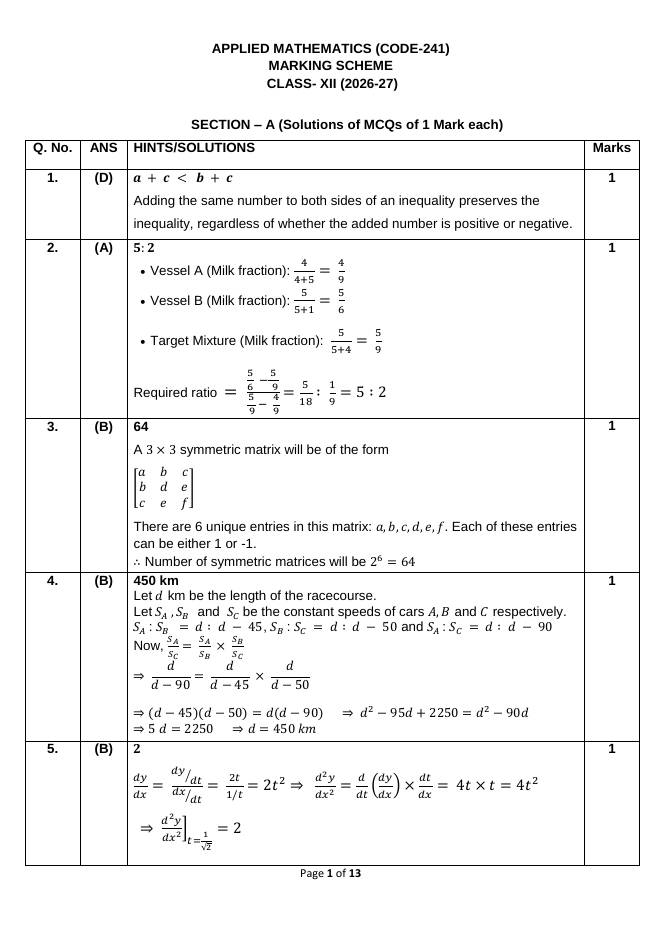
1. (D) 𝒂 + 𝒄 < 𝒃 + 𝒄 1 Adding the same number to both sides of an inequality preserves the inequality, regardless of whether the added number is positive or negative.Original pages for Question 1
 Motivation"Strength does not come from physical capacity. It comes from an indomitable will." : Mahatma GandhiNow write it yourselfYou have read, listened and understood. Now close the answer, take a blank page and write and solve this question on your own, in proper CBSE format, with a timer running. Then check against the model answer. That effort will give you confidence for this type and similar types of questions.
- Question 21 mark
2.    Vessel A contains milk and water in the ratio 4 : 5. Vessel B contains milk and                      1
            water in the ratio 5 : 1. In what ratio should quantities be taken from both vessels
            to form a mixture in which milk and water are in the ratio 5 : 4?
            (A) 5 : 2          (B) 5 : 3            (C) 4 : 1           (D) 1 : 4
Official CBSE answer and marking
2. (A) 𝟓: 𝟐 1 4 4 Vessel A (Milk fraction): = 4+5 9 5 5 Vessel B (Milk fraction): = 5+1 6 5 5 Target Mixture (Milk fraction): = 5+4 9 5 5 6 −9 5 1 Required ratio = 5 4 = 18 ∶ 9 = 5 ∶ 2 − 9 9Original pages for Question 2
Motivation"The future depends on what you do today." : Mahatma Gandhi (attributed)Now write it yourselfYou have read, listened and understood. Now close the answer, take a blank page and write and solve this question on your own, in proper CBSE format, with a timer running. Then check against the model answer. That effort will give you confidence for this type and similar types of questions. - Question 31 mark
3.    Number of symmetric matrices of order 3 × 3 with each entry 1 or −1 is                               1
            (A) 512       (B) 64            (C) 8              (D) 4
Official CBSE answer and marking
3.     (B)   64                                                                                     1
               A 3 × 3 symmetric matrix will be of the form
                𝑎     𝑏    𝑐
               [𝑏     𝑑    𝑒]
                𝑐     𝑒    𝑓
               There are 6 unique entries in this matrix: 𝑎, 𝑏, 𝑐, 𝑑, 𝑒, 𝑓. Each of these entries
               can be either 1 or -1.
               ∴ Number of symmetric matrices will be 26 = 64
Independent verification noteThe source calculation is 2⁶ = 64. Plain-text extraction loses the superscript and may display 26 = 64; use the original page for mathematical layout.Original pages for Question 3
Motivation"Where the mind is without fear and the head is held high, where knowledge is free." : Rabindranath TagoreNow write it yourselfYou have read, listened and understood. Now close the answer, take a blank page and write and solve this question on your own, in proper CBSE format, with a timer running. Then check against the model answer. That effort will give you confidence for this type and similar types of questions. - Question 41 mark
4.    In a car race, car A beats car B by 45 km, car B beats car C by 50 km, and car                       1
            A beats car C by 90 km then the length of the race course is
            (A) 400 km        (B) 450 km        (C) 500 km         (D) 550 km
*There is no change in the Question Paper Design and Assessment Pattern for Academic Session 2026-27
Official CBSE answer and marking
4. (B) 450 km 1 Let 𝑑 km be the length of the racecourse. Let 𝑆𝐴 , 𝑆𝐵 and 𝑆𝐶 be the constant speeds of cars 𝐴, 𝐵 and 𝐶 respectively. 𝑆𝐴 : 𝑆𝐵 = 𝑑 ∶ 𝑑 − 45, 𝑆𝐵 : 𝑆𝐶 = 𝑑 ∶ 𝑑 − 50 and 𝑆𝐴 : 𝑆𝐶 = 𝑑 ∶ 𝑑 − 90 𝑆 𝑆 𝑆 Now, 𝑆𝐴 = 𝑆𝐴 × 𝑆𝐵 𝐶 𝐵 𝐶 𝑑 𝑑 𝑑 ⇒ = × 𝑑 − 90 𝑑 − 45 𝑑 − 50 ⇒ (𝑑 − 45)(𝑑 − 50) = 𝑑(𝑑 − 90) ⇒ 𝑑2 − 95𝑑 + 2250 = 𝑑 2 − 90𝑑 ⇒ 5 𝑑 = 2250 ⇒ 𝑑 = 450 𝑘𝑚Original pages for Question 4
Motivation"Become capable, and success will chase you." : 3 Idiots (2009 film)Now write it yourselfYou have read, listened and understood. Now close the answer, take a blank page and write and solve this question on your own, in proper CBSE format, with a timer running. Then check against the model answer. That effort will give you confidence for this type and similar types of questions. - Question 51 mark
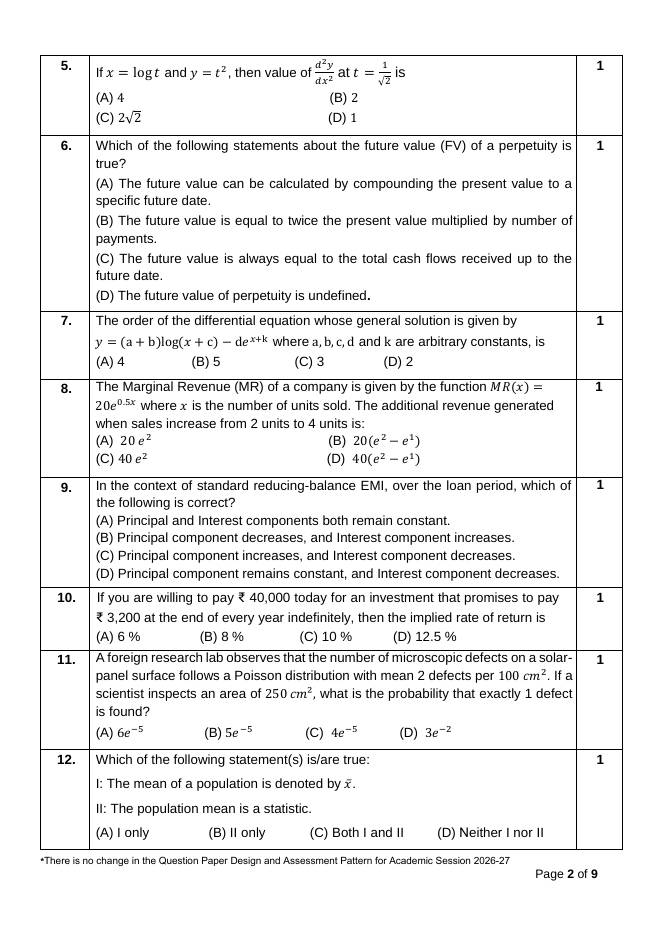
5.                                                    𝑑2𝑦             1                                      1
           If 𝑥 = log 𝑡 and 𝑦 = 𝑡 2 , then value of              at 𝑡 =        is
                                                          𝑑𝑥 2            √2
           (A) 4                                              (B) 2
           (C) 2√2                                            (D) 1
Official CBSE answer and marking
5. (B) 𝟐 1 𝑑𝑦⁄ 𝑑𝑦 2𝑡 𝑑2𝑦 𝑑 𝑑𝑦 𝑑𝑡 = 𝑑𝑥 𝑑𝑡 = = 2𝑡 2 ⇒ = ( ) × 𝑑𝑥 = 4𝑡 × 𝑡 = 4𝑡 2 𝑑𝑥 ⁄𝑑𝑡 1/𝑡 𝑑𝑥 2 𝑑𝑡 𝑑𝑥 𝑑2𝑦 ⇒ ] =2 𝑑𝑥 2 𝑡= 1 √2Original pages for Question 5
 Motivation"Cultivate the habit of being grateful for every good thing that comes to you." : Ramakrishna Paramahamsa (attributed)Now write it yourselfYou have read, listened and understood. Now close the answer, take a blank page and write and solve this question on your own, in proper CBSE format, with a timer running. Then check against the model answer. That effort will give you confidence for this type and similar types of questions.
- Question 61 mark
6.     Which of the following statements about the future value (FV) of a perpetuity is                      1
           true?
           (A) The future value can be calculated by compounding the present value to a
           specific future date.
           (B) The future value is equal to twice the present value multiplied by number of
           payments.
           (C) The future value is always equal to the total cash flows received up to the
           future date.
           (D) The future value of perpetuity is undefined.
Official CBSE answer and marking
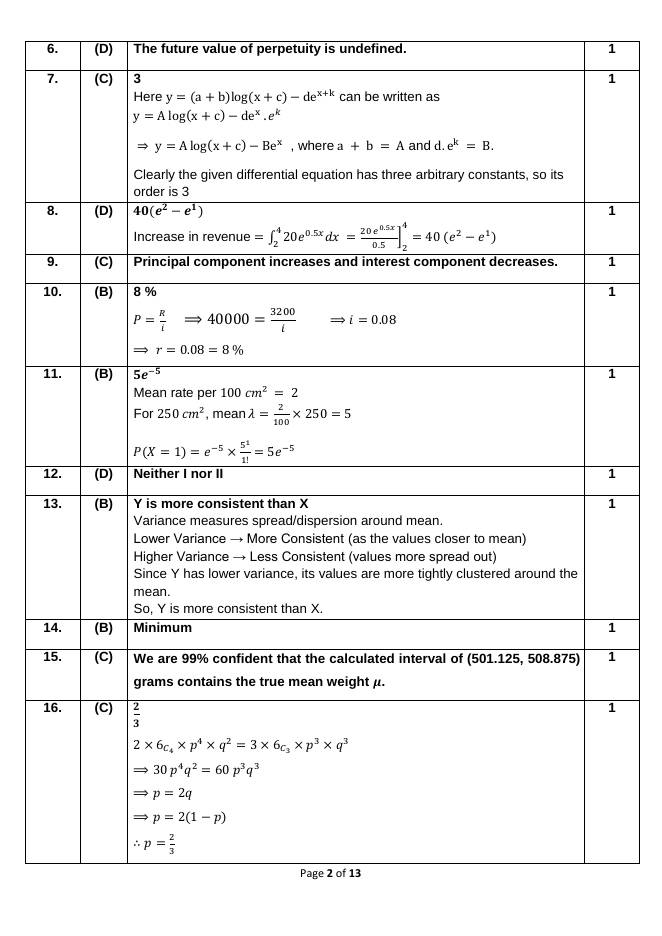
6. (D) The future value of perpetuity is undefined. 1
Independent verification noteOfficial option D refers to no finite terminal future value for the entire perpetuity. A present value can nevertheless be compounded to a specified finite valuation date; the broad wording needs that distinction.Original pages for Question 6
 Motivation"Education is the most powerful weapon which you can use to change the world." : Nelson MandelaNow write it yourselfYou have read, listened and understood. Now close the answer, take a blank page and write and solve this question on your own, in proper CBSE format, with a timer running. Then check against the model answer. That effort will give you confidence for this type and similar types of questions.
- Question 71 mark
7.     The order of the differential equation whose general solution is given by                             1
                                            𝑥+k where a, b, c, d and k are arbitrary constants, is
           𝑦 = (a + b)log(𝑥 + c) − d𝑒
           (A) 4           (B) 5                      (C) 3               (D) 2
Official CBSE answer and marking
7. (C) 3 1 Here y = (a + b)log(x + c) − dex+k can be written as y = A log(x + c) − dex . 𝑒 𝑘 ⇒ y = A log(x + c) − Bex , where a + b = A and d. ek = B. Clearly the given differential equation has three arbitrary constants, so its order is 3Original pages for Question 7
Motivation"It always seems impossible until it is done." : Nelson Mandela (attributed)Now write it yourselfYou have read, listened and understood. Now close the answer, take a blank page and write and solve this question on your own, in proper CBSE format, with a timer running. Then check against the model answer. That effort will give you confidence for this type and similar types of questions. - Question 81 mark
8.     The Marginal Revenue (MR) of a company is given by the function 𝑀𝑅(𝑥) =                               1
           20𝑒 0.5𝑥 where 𝑥 is the number of units sold. The additional revenue generated
           when sales increase from 2 units to 4 units is:
           (A) 20 𝑒 2                               (B) 20(𝑒 2 − 𝑒 1 )
           (C) 40 𝑒 2                               (D) 40(𝑒 2 − 𝑒 1 )
Official CBSE answer and marking
8. (D) 𝟒𝟎(𝒆𝟐 − 𝒆𝟏 ) 1 4 4 20 𝑒 0.5𝑥 Increase in revenue = ∫2 20𝑒 0.5𝑥 𝑑𝑥 = ] = 40 (𝑒 2 − 𝑒 1 ) 0.5 2Original pages for Question 8
Motivation"Genius is one percent inspiration and ninety nine percent perspiration." : Thomas EdisonNow write it yourselfYou have read, listened and understood. Now close the answer, take a blank page and write and solve this question on your own, in proper CBSE format, with a timer running. Then check against the model answer. That effort will give you confidence for this type and similar types of questions. - Question 91 mark
9.     In the context of standard reducing-balance EMI, over the loan period, which of                       1
           the following is correct?
           (A) Principal and Interest components both remain constant.
           (B) Principal component decreases, and Interest component increases.
           (C) Principal component increases, and Interest component decreases.
           (D) Principal component remains constant, and Interest component decreases.
Official CBSE answer and marking
9. (C) Principal component increases and interest component decreases. 1
Original pages for Question 9
Motivation"I have not failed. I have just found 10,000 ways that will not work." : Thomas Edison (attributed)Now write it yourselfYou have read, listened and understood. Now close the answer, take a blank page and write and solve this question on your own, in proper CBSE format, with a timer running. Then check against the model answer. That effort will give you confidence for this type and similar types of questions. - Question 101 mark
10.     If you are willing to pay ₹ 40,000 today for an investment that promises to pay                       1
           ₹ 3,200 at the end of every year indefinitely, then the implied rate of return is
           (A) 6 %             (B) 8 %         (C) 10 %         (D) 12.5 %
Official CBSE answer and marking
10. (B) 8% 1 𝑅 3200 𝑃= 𝑖 ⟹ 40000 = ⟹ 𝑖 = 0.08 𝑖 ⟹ 𝑟 = 0.08 = 8 %Original pages for Question 10
Motivation"It does not matter how slowly you go as long as you do not stop." : Confucius (attributed)Now write it yourselfYou have read, listened and understood. Now close the answer, take a blank page and write and solve this question on your own, in proper CBSE format, with a timer running. Then check against the model answer. That effort will give you confidence for this type and similar types of questions. - Question 111 mark
11.     A foreign research lab observes that the number of microscopic defects on a solar-                    1
           panel surface follows a Poisson distribution with mean 2 defects per 100 𝑐𝑚2. If a
           scientist inspects an area of 250 𝑐𝑚², what is the probability that exactly 1 defect
           is found?
           (A) 6𝑒 −5              (B) 5𝑒 −5             (C) 4𝑒 −5              (D) 3𝑒 −2
Official CBSE answer and marking
11. (B) 𝟓𝒆−𝟓 1 Mean rate per 100 𝑐𝑚² = 2 2 For 250 𝑐𝑚², mean 𝜆 = 100 × 250 = 5 51 𝑃(𝑋 = 1) = 𝑒 −5 × 1! = 5𝑒 −5Original pages for Question 11
Motivation"Learning never exhausts the mind." : Leonardo da VinciNow write it yourselfYou have read, listened and understood. Now close the answer, take a blank page and write and solve this question on your own, in proper CBSE format, with a timer running. Then check against the model answer. That effort will give you confidence for this type and similar types of questions. - Question 121 mark
12.     Which of the following statement(s) is/are true:                                                      1
           I: The mean of a population is denoted by 𝑥̅ .
           II: The population mean is a statistic.
           (A) I only              (B) II only           (C) Both I and II           (D) Neither I nor II
*There is no change in the Question Paper Design and Assessment Pattern for Academic Session 2026-27
Official CBSE answer and marking
12. (D) Neither I nor II 1
Original pages for Question 12
Motivation"Do not watch the clock; do what it does. Keep going." : Sam LevensonNow write it yourselfYou have read, listened and understood. Now close the answer, take a blank page and write and solve this question on your own, in proper CBSE format, with a timer running. Then check against the model answer. That effort will give you confidence for this type and similar types of questions. - Question 131 mark
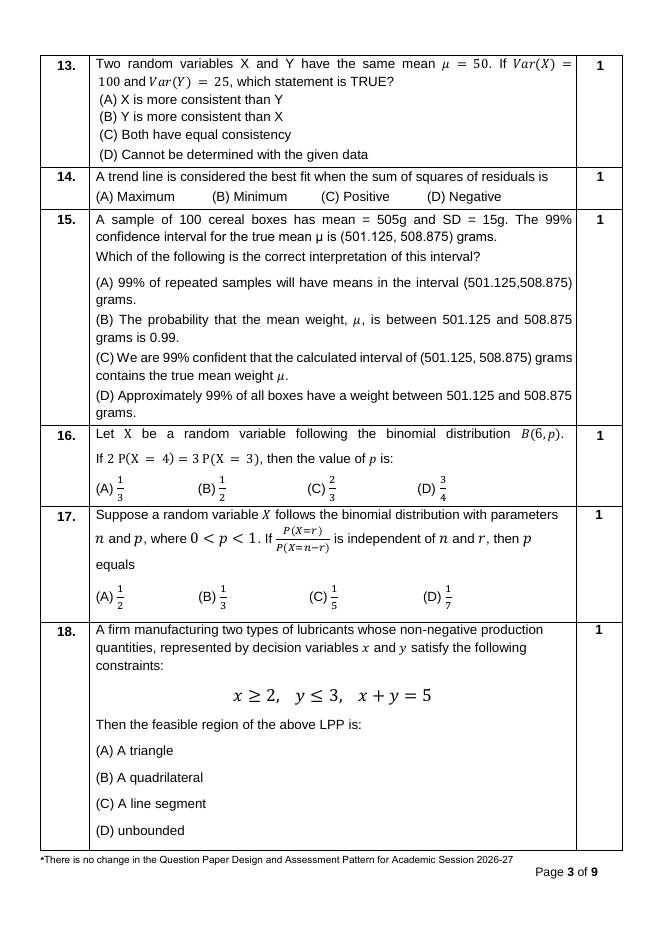
13.     Two random variables X and Y have the same mean 𝜇 = 50. If 𝑉𝑎𝑟(𝑋) =                                   1
           100 and 𝑉𝑎𝑟(𝑌) = 25, which statement is TRUE?
           (A) X is more consistent than Y
           (B) Y is more consistent than X
           (C) Both have equal consistency
           (D) Cannot be determined with the given data
Official CBSE answer and marking
13. (B) Y is more consistent than X 1 Variance measures spread/dispersion around mean. Lower Variance → More Consistent (as the values closer to mean) Higher Variance → Less Consistent (values more spread out) Since Y has lower variance, its values are more tightly clustered around the mean. So, Y is more consistent than X.Original pages for Question 13
 Motivation"You do not have to be great to start, but you have to start to be great." : Zig ZiglarNow write it yourselfYou have read, listened and understood. Now close the answer, take a blank page and write and solve this question on your own, in proper CBSE format, with a timer running. Then check against the model answer. That effort will give you confidence for this type and similar types of questions.
- Question 141 mark
14.     A trend line is considered the best fit when the sum of squares of residuals is                       1
           (A) Maximum          (B) Minimum         (C) Positive     (D) Negative
Official CBSE answer and marking
14. (B) Minimum 1
Original pages for Question 14
Motivation"An investment in knowledge pays the best interest." : Benjamin Franklin (attributed)Now write it yourselfYou have read, listened and understood. Now close the answer, take a blank page and write and solve this question on your own, in proper CBSE format, with a timer running. Then check against the model answer. That effort will give you confidence for this type and similar types of questions. - Question 151 mark
15.     A sample of 100 cereal boxes has mean = 505g and SD = 15g. The 99%                                    1
           confidence interval for the true mean μ is (501.125, 508.875) grams.
           Which of the following is the correct interpretation of this interval?
           (A) 99% of repeated samples will have means in the interval (501.125,508.875)
           grams.
           (B) The probability that the mean weight, 𝜇, is between 501.125 and 508.875
           grams is 0.99.
           (C) We are 99% confident that the calculated interval of (501.125, 508.875) grams
           contains the true mean weight 𝜇.
           (D) Approximately 99% of all boxes have a weight between 501.125 and 508.875
           grams.
Official CBSE answer and marking
15. (C) We are 99% confident that the calculated interval of (501.125, 508.875) 1 grams contains the true mean weight 𝝁.Original pages for Question 15
Motivation"Pure mathematics is, in its way, the poetry of logical ideas." : Albert EinsteinNow write it yourselfYou have read, listened and understood. Now close the answer, take a blank page and write and solve this question on your own, in proper CBSE format, with a timer running. Then check against the model answer. That effort will give you confidence for this type and similar types of questions. - Question 161 mark
16.     Let X be a random variable following the binomial distribution 𝐵(6, p).                               1
           If 2 P(X = 4) = 3 P(X = 3), then the value of p is:
                 1                     1                      2                      3
           (A)                   (B)                    (C)                    (D)
                 3                     2                      3                      4
Official CBSE answer and marking
16.   (C)   𝟐                                                                               1
            𝟑
            2 × 6𝐶4 × 𝑝4 × 𝑞 2 = 3 × 6𝐶3 × 𝑝3 × 𝑞 3
            ⟹ 30 𝑝4 𝑞 2 = 60 𝑝3 𝑞 3
            ⟹ 𝑝 = 2𝑞
            ⟹ 𝑝 = 2(1 − 𝑝)
                     2
            ∴𝑝=3
Independent verification noteThe intended MCQ answer is option C, p = 2/3. Division by p³(1-p)² assumes 0 < p < 1. If degenerate binomial distributions are permitted, the complete solution set is {0, 2/3, 1}.Original pages for Question 16
Motivation"Success is the sum of small efforts, repeated day in and day out." : Robert CollierNow write it yourselfYou have read, listened and understood. Now close the answer, take a blank page and write and solve this question on your own, in proper CBSE format, with a timer running. Then check against the model answer. That effort will give you confidence for this type and similar types of questions. - Question 171 mark
17.     Suppose a random variable 𝑋 follows the binomial distribution with parameters                         1
                                                   𝑃(𝑋=𝑟)
           𝑛 and 𝑝, where 0 < 𝑝 < 1. If                       is independent of 𝑛 and 𝑟, then 𝑝
                                                 𝑃(𝑋=𝑛−𝑟)
           equals
                 1                     1                      1                       1
           (A)                   (B)                    (C)                     (D)
                 2                     3                      5                       7
Official CBSE answer and marking
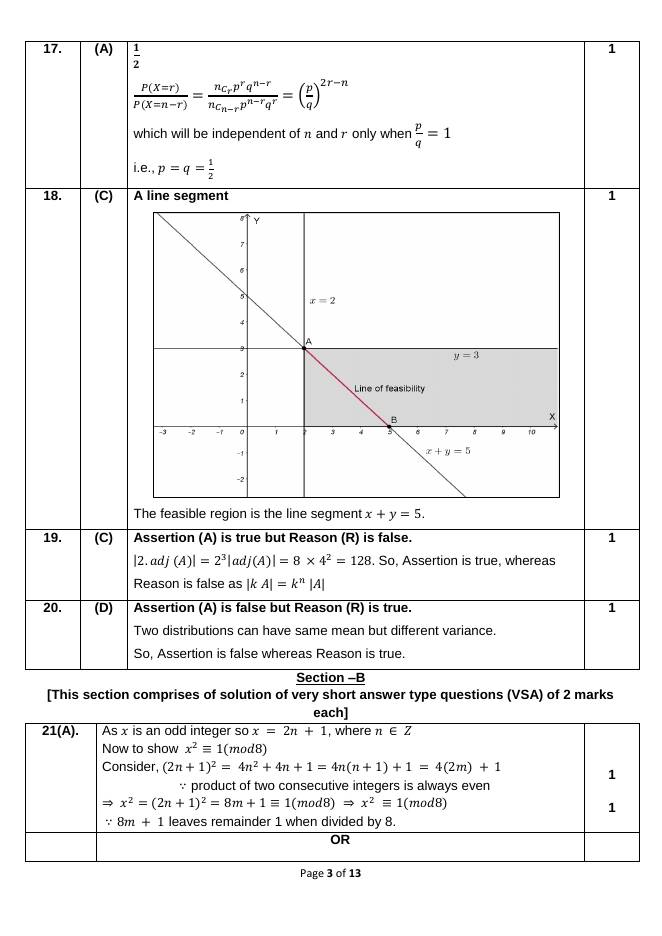
17. (A) 𝟏 1 𝟐 𝑃(𝑋=𝑟) 𝑛𝐶𝑟 𝑝𝑟 𝑞 𝑛−𝑟 𝑝 2𝑟−𝑛 = 𝑛−𝑟 𝑟 =( ) 𝑃(𝑋=𝑛−𝑟) 𝑛𝐶𝑛−𝑟 𝑝 𝑞 𝑞 𝑝 which will be independent of 𝑛 and 𝑟 only when =1 𝑞 1 i.e., 𝑝 = 𝑞 = 2Original pages for Question 17
 Motivation"The expert in anything was once a beginner." : Helen Hayes (attributed)Now write it yourselfYou have read, listened and understood. Now close the answer, take a blank page and write and solve this question on your own, in proper CBSE format, with a timer running. Then check against the model answer. That effort will give you confidence for this type and similar types of questions.
- Question 181 mark
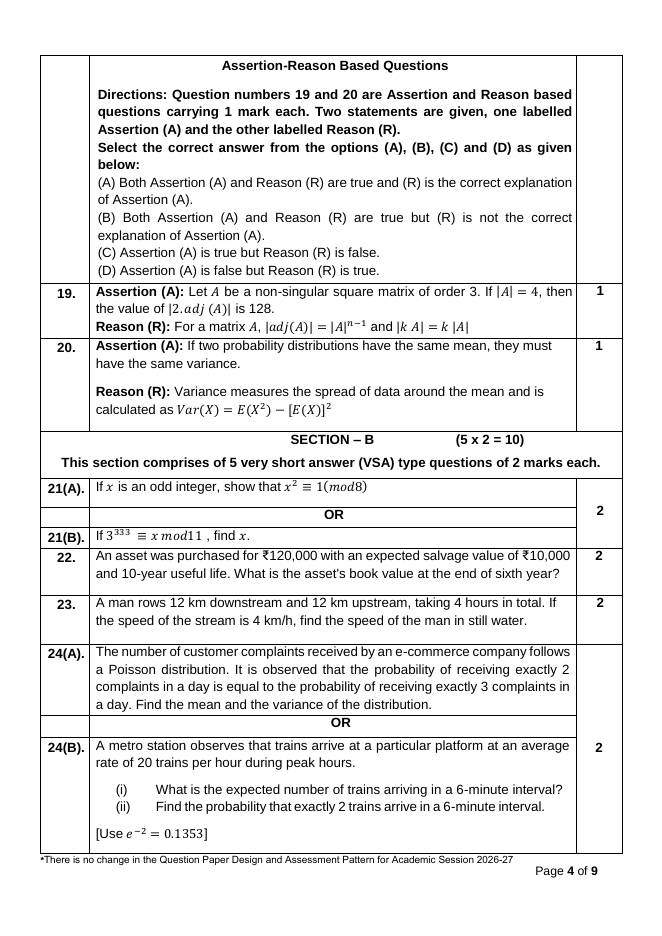
18.     A firm manufacturing two types of lubricants whose non-negative production                            1
           quantities, represented by decision variables 𝑥 and 𝑦 satisfy the following
           constraints:
                                           𝑥 ≥ 2, 𝑦 ≤ 3, 𝑥 + 𝑦 = 5
           Then the feasible region of the above LPP is:
           (A) A triangle
           (B) A quadrilateral
           (C) A line segment
           (D) unbounded
*There is no change in the Question Paper Design and Assessment Pattern for Academic Session 2026-27
                                      Assertion-Reason Based Questions
            Directions: Question numbers 19 and 20 are Assertion and Reason based
            questions carrying 1 mark each. Two statements are given, one labelled
            Assertion (A) and the other labelled Reason (R).
            Select the correct answer from the options (A), (B), (C) and (D) as given
            below:
            (A) Both Assertion (A) and Reason (R) are true and (R) is the correct explanation
            of Assertion (A).
            (B) Both Assertion (A) and Reason (R) are true but (R) is not the correct
            explanation of Assertion (A).
            (C) Assertion (A) is true but Reason (R) is false.
            (D) Assertion (A) is false but Reason (R) is true.
Official CBSE answer and marking
18. (C) A line segment 1 The feasible region is the line segment 𝑥 + 𝑦 = 5.Original pages for Question 18
 Motivation"Chase your dreams. Dreams do come true." : Sachin Tendulkar, CricketNow write it yourselfYou have read, listened and understood. Now close the answer, take a blank page and write and solve this question on your own, in proper CBSE format, with a timer running. Then check against the model answer. That effort will give you confidence for this type and similar types of questions.
- Question 191 mark
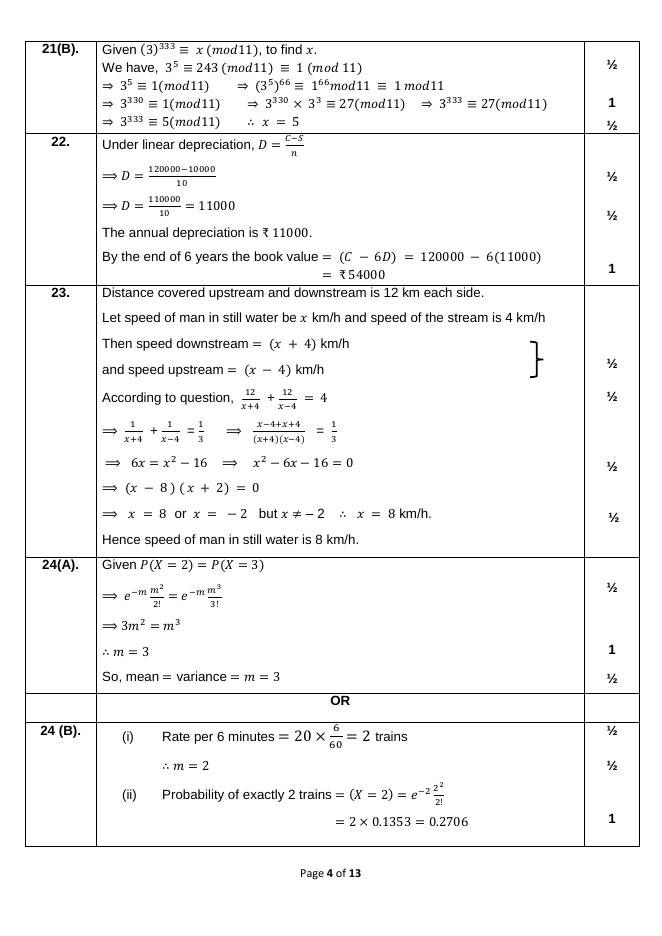
19.     Assertion (A): Let 𝐴 be a non-singular square matrix of order 3. If |𝐴| = 4, then                     1
           the value of |2. 𝑎𝑑𝑗 (𝐴)| is 128.
           Reason (R): For a matrix 𝐴, |𝑎𝑑𝑗(𝐴)| = |𝐴|𝑛−1 and |𝑘 𝐴| = 𝑘 |𝐴|
Official CBSE answer and marking
19. (C) Assertion (A) is true but Reason (R) is false. 1 |2. 𝑎𝑑𝑗 (𝐴)| = 23 |𝑎𝑑𝑗(𝐴)| = 8 × 42 = 128. So, Assertion is true, whereas Reason is false as |𝑘 𝐴| = 𝑘 𝑛 |𝐴|Original pages for Question 19
Motivation"Self belief and hard work will always earn you success." : Virat Kohli, Cricket (attributed)Now write it yourselfYou have read, listened and understood. Now close the answer, take a blank page and write and solve this question on your own, in proper CBSE format, with a timer running. Then check against the model answer. That effort will give you confidence for this type and similar types of questions. - Question 201 mark
20.     Assertion (A): If two probability distributions have the same mean, they must                         1
           have the same variance.
           Reason (R): Variance measures the spread of data around the mean and is
           calculated as 𝑉𝑎𝑟(𝑋) = 𝐸(𝑋 2 ) − [𝐸(𝑋)]2
Official CBSE answer and marking
20. (D) Assertion (A) is false but Reason (R) is true. 1 Two distributions can have same mean but different variance. So, Assertion is false whereas Reason is true.Original pages for Question 20
Motivation"Focus on the process, and the results will follow." : M. S. Dhoni, Cricket (attributed)Now write it yourselfYou have read, listened and understood. Now close the answer, take a blank page and write and solve this question on your own, in proper CBSE format, with a timer running. Then check against the model answer. That effort will give you confidence for this type and similar types of questions. - Question 212 marks
21(A). If 𝑥 is an odd integer, show that 𝑥 ≡ 1(𝑚𝑜𝑑8)
                                                           OR                                                    2
            333
 21(B). If 3    ≡ 𝑥 𝑚𝑜𝑑11 , find 𝑥.
Official CBSE answer and marking
21(A).    As 𝑥 is an odd integer so 𝑥 = 2𝑛 + 1, where 𝑛 ∈ 𝑍
          Now to show 𝑥 2 ≡ 1(𝑚𝑜𝑑8)
          Consider, (2𝑛 + 1)2 = 4𝑛2 + 4𝑛 + 1 = 4𝑛(𝑛 + 1) + 1 = 4(2𝑚) + 1
                                                                                        1
                       ∵ product of two consecutive integers is always even
          ⇒ 𝑥 2 = (2𝑛 + 1)2 = 8𝑚 + 1 ≡ 1(𝑚𝑜𝑑8) ⇒ 𝑥 2 ≡ 1(𝑚𝑜𝑑8)                          1
          ∵ 8𝑚 + 1 leaves remainder 1 when divided by 8.
                                                OR
21(B).    Given (3)333 ≡ 𝑥 (𝑚𝑜𝑑11), to find 𝑥.
          We have, 35 ≡ 243 (𝑚𝑜𝑑11) ≡ 1 (𝑚𝑜𝑑 11)                                            ½
          ⇒ 35 ≡ 1(𝑚𝑜𝑑11)      ⇒ (35 )66 ≡ 166 𝑚𝑜𝑑11 ≡ 1 𝑚𝑜𝑑11
          ⇒ 3330 ≡ 1(𝑚𝑜𝑑11)     ⇒ 3330 × 33 ≡ 27(𝑚𝑜𝑑11) ⇒ 3333 ≡ 27(𝑚𝑜𝑑11)                  1
          ⇒ 3333 ≡ 5(𝑚𝑜𝑑11)     ∴ 𝑥 = 5                                                     ½
Independent verification noteQ21A asks to prove x² ≡ 1 (mod 8) for odd x. The square can disappear in plain-text extraction; the original page preserves it.Original pages for Question 21
 Motivation"Hard work beats talent when talent does not work hard." : Tim Notke, Basketball coachNow write it yourselfYou have read, listened and understood. Now close the answer, take a blank page and write and solve this question on your own, in proper CBSE format, with a timer running. Then check against the model answer. That effort will give you confidence for this type and similar types of questions.
- Question 222 marks
22.   An asset was purchased for ₹120,000 with an expected salvage value of ₹10,000                            2
        and 10-year useful life. What is the asset's book value at the end of sixth year?
Official CBSE answer and marking
22.                                                    𝐶−𝑆
          Under linear depreciation, 𝐷 =                 𝑛
                    120000−10000
          ⟹𝐷=                                                                               ½
                             10
                    110000
          ⟹𝐷=                 = 11000
                     10                                                                     ½
          The annual depreciation is ₹ 11000.
          By the end of 6 years the book value = (𝐶 − 6𝐷) = 120000 − 6(11000)
                                               = ₹ 54000                                    1
Independent verification noteThe official ₹54,000 book value assumes straight-line depreciation. The printed question does not expressly specify the method.Original pages for Question 22
Motivation"Champions keep playing until they get it right." : Billie Jean King, TennisNow write it yourselfYou have read, listened and understood. Now close the answer, take a blank page and write and solve this question on your own, in proper CBSE format, with a timer running. Then check against the model answer. That effort will give you confidence for this type and similar types of questions. - Question 232 marks
23.     A man rows 12 km downstream and 12 km upstream, taking 4 hours in total. If                           2
           the speed of the stream is 4 km/h, find the speed of the man in still water.
Official CBSE answer and marking
23. Distance covered upstream and downstream is 12 km each side. Let speed of man in still water be 𝑥 km/h and speed of the stream is 4 km/h Then speed downstream = (𝑥 + 4) km/h and speed upstream = (𝑥 − 4) km/h ½ 12 12 According to question, 𝑥+4 + 𝑥−4 = 4 ½ 1 1 1 𝑥−4+𝑥+4 1 ⟹ 𝑥+4 + 𝑥−4 = 3 ⟹ = 3 (𝑥+4)(𝑥−4) ⟹ 6𝑥 = 𝑥 2 − 16 ⟹ 𝑥 2 − 6𝑥 − 16 = 0 ½ ⟹ (𝑥 − 8 ) ( 𝑥 + 2) = 0 ⟹ 𝑥 = 8 or 𝑥 = − 2 but 𝑥 ≠ - 2 ∴ 𝑥 = 8 km/h. ½ Hence speed of man in still water is 8 km/h.Original pages for Question 23
Motivation"I have failed over and over and over again in my life. And that is why I succeed." : Michael Jordan, BasketballNow write it yourselfYou have read, listened and understood. Now close the answer, take a blank page and write and solve this question on your own, in proper CBSE format, with a timer running. Then check against the model answer. That effort will give you confidence for this type and similar types of questions. - Question 242 marks
24(A). The number of customer complaints received by an e-commerce company follows
        a Poisson distribution. It is observed that the probability of receiving exactly 2
        complaints in a day is equal to the probability of receiving exactly 3 complaints in
        a day. Find the mean and the variance of the distribution.
                                                 OR
 24(B). A metro station observes that trains arrive at a particular platform at an average                       2
        rate of 20 trains per hour during peak hours.
               (i)      What is the expected number of trains arriving in a 6-minute interval?
               (ii)     Find the probability that exactly 2 trains arrive in a 6-minute interval.
           [Use 𝑒 −2 = 0.1353]
*There is no change in the Question Paper Design and Assessment Pattern for Academic Session 2026-27
Official CBSE answer and marking
24(A).    Given 𝑃(𝑋 = 2) = 𝑃(𝑋 = 3)
                    𝑚2                𝑚3                                                    ½
          ⟹ 𝑒 −𝑚 2! = 𝑒 −𝑚 3!
          ⟹ 3𝑚2 = 𝑚3
          ∴𝑚=3                                                                              1
          So, mean = variance = 𝑚 = 3                                                       ½
                                                                  OR
24 (B).                                                            6                        ½
             (i)      Rate per 6 minutes = 20 ×                         = 2 trains
                                                                  60
                      ∴𝑚=2                                                                  ½
                                                                                       22
             (ii)     Probability of exactly 2 trains = (𝑋 = 2) = 𝑒 −2 2!
                                                                   = 2 × 0.1353 = 0.2706    1
Independent verification noteFor Q24A, assuming a nondegenerate Poisson parameter λ > 0 gives mean = variance = 3. If λ = 0 is allowed, P(X=2) = P(X=3) = 0 also satisfies the premise.Original pages for Question 24
Motivation"Everything negative, pressure, challenges, is all an opportunity for me to rise." : Kobe Bryant, BasketballNow write it yourselfYou have read, listened and understood. Now close the answer, take a blank page and write and solve this question on your own, in proper CBSE format, with a timer running. Then check against the model answer. That effort will give you confidence for this type and similar types of questions. - Question 252 marks
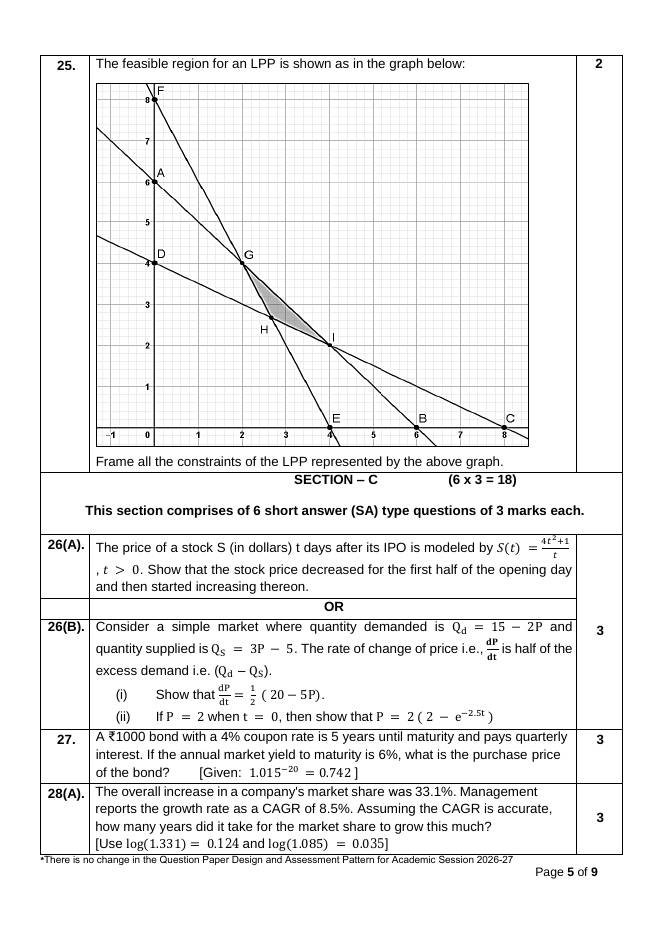
25.     The feasible region for an LPP is shown as in the graph below:                                        2
           Frame all the constraints of the LPP represented by the above graph.
Official CBSE answer and marking
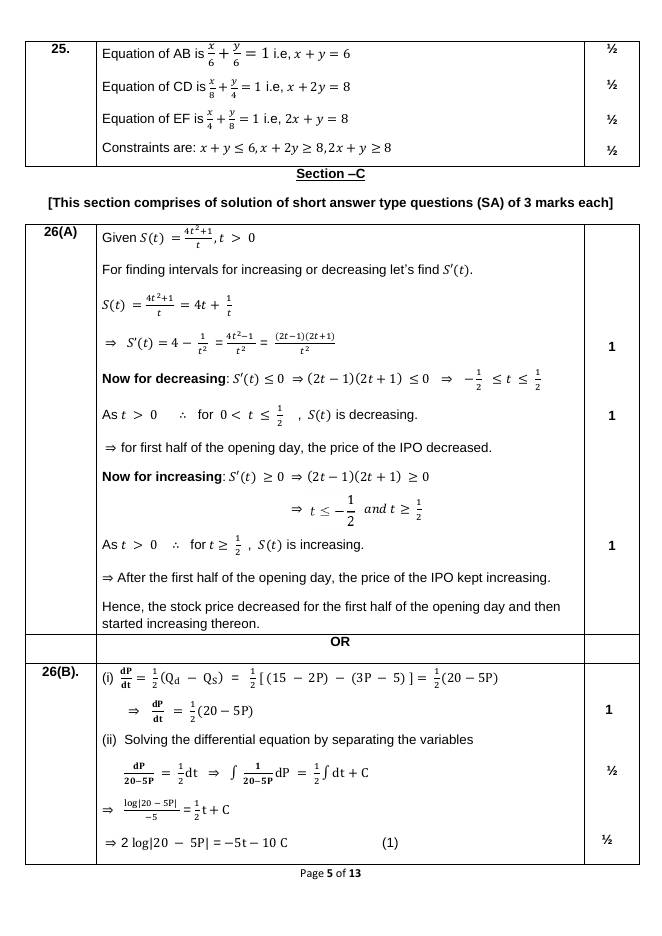
25. 𝑥 𝑦 ½ Equation of AB is + = 1 i.e, 𝑥 + 𝑦 = 6 6 6 𝑥 𝑦 Equation of CD is 8 + 4 = 1 i.e, 𝑥 + 2𝑦 = 8 ½ 𝑥 𝑦 Equation of EF is 4 + 8 = 1 i.e, 2𝑥 + 𝑦 = 8 ½ Constraints are: 𝑥 + 𝑦 ≤ 6, 𝑥 + 2𝑦 ≥ 8, 2𝑥 + 𝑦 ≥ 8 ½Original pages for Question 25
 Motivation"A winner is someone who recognises his God given talents, works his tail off to develop them into skills, and uses these skills to accomplish his goals." : Larry Bird, BasketballNow write it yourselfYou have read, listened and understood. Now close the answer, take a blank page and write and solve this question on your own, in proper CBSE format, with a timer running. Then check against the model answer. That effort will give you confidence for this type and similar types of questions.
- Question 263 marks
26(A). The price of a stock S (in dollars) t days after its IPO is modeled by 𝑆(𝑡) = 4𝑡 +1
                                                                                        𝑡
           , 𝑡 > 0. Show that the stock price decreased for the first half of the opening day
           and then started increasing thereon.
                                                 OR
 26(B). Consider a simple market where quantity demanded is Qd = 15 − 2P and                                     3
                                                                                              𝐝𝐏
           quantity supplied is QS = 3P − 5. The rate of change of price i.e., 𝐝𝐭 is half of the
           excess demand i.e. (Qd - QS ).
                                     dP     1
               (i)      Show that dt = 2 ( 20 − 5P).
               (ii)     If P = 2 when t = 0, then show that P = 2 ( 2 − e−2.5t )
Official CBSE answer and marking
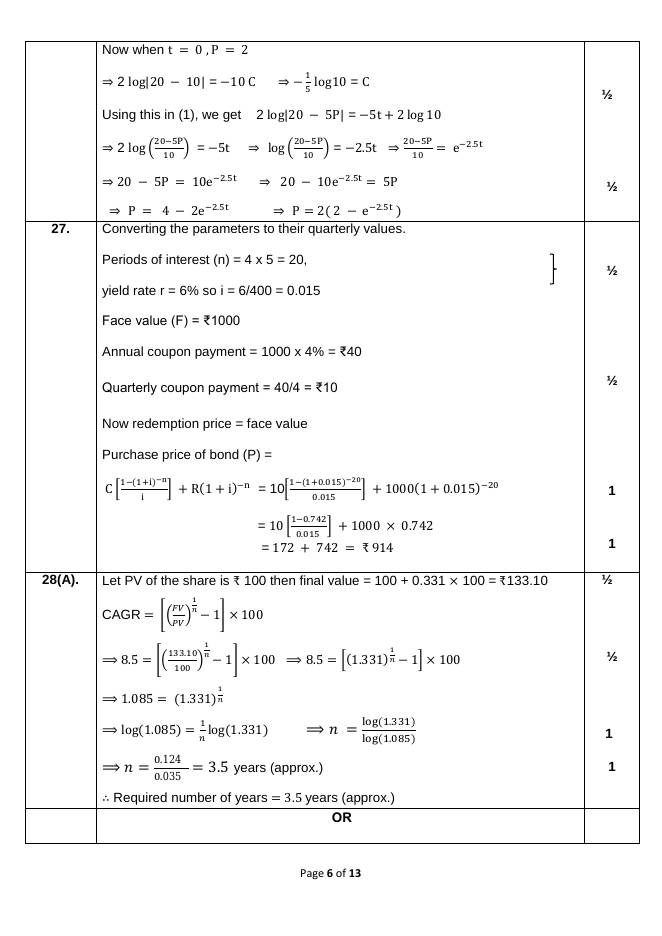
26(A) 4𝑡 2 +1 Given 𝑆(𝑡) = ,𝑡 > 0 𝑡 For finding intervals for increasing or decreasing let’s find 𝑆′(𝑡). 4𝑡 2 +1 1 𝑆(𝑡) = = 4𝑡 + 𝑡 𝑡 1 4𝑡 2 −1 (2𝑡−1)(2𝑡+1) ⇒ 𝑆’(𝑡) = 4 − 𝑡 2 = = 1 𝑡2 𝑡2 1 1 Now for decreasing: 𝑆′(𝑡) ≤ 0 ⇒ (2𝑡 − 1)(2𝑡 + 1) ≤ 0 ⇒ − 2 ≤ 𝑡 ≤ 2 1 As 𝑡 > 0 ∴ for 0 < 𝑡 ≤ 2 , 𝑆(𝑡) is decreasing. 1 ⇒ for first half of the opening day, the price of the IPO decreased. Now for increasing: 𝑆′(𝑡) ≥ 0 ⇒ (2𝑡 − 1)(2𝑡 + 1) ≥ 0 ⇒ − 2 -≤ 𝑡 𝑎𝑛𝑑 𝑡 ≥ 2 1 1 1 As 𝑡 > 0 ∴ for 𝑡 ≥ 2 , 𝑆(𝑡) is increasing. 1 ⇒ After the first half of the opening day, the price of the IPO kept increasing. Hence, the stock price decreased for the first half of the opening day and then started increasing thereon. OR 26(B). 𝐝𝐏 1 (i) 𝐝𝐭 = 2 (Qd − QS ) = 1 1 [ (15 − 2P) − (3P − 5) ] = 2 (20 − 5P) 2 𝐝𝐏 1 ⇒ = 2 (20 − 5P) 1 𝐝𝐭 (ii) Solving the differential equation by separating the variables 𝐝𝐏 1 𝟏 1 = 2 dt ⇒ ∫ 𝟐𝟎−𝟓𝐏 dP = 2 ∫ dt + C ½ 𝟐𝟎−𝟓𝐏 log|20 − 5P| 1 ⇒ = 2t + C −5 ⇒ 2 log|20 − 5P| = −5t − 10 C (1) ½ Now when t = 0 , P = 2 1 ⇒ 2 log|20 − 10| = −10 C ⇒ − log10 = C 5 ½ Using this in (1), we get 2 log|20 − 5P| = −5t + 2 log 10 20−5P 20−5P 20−5P ⇒ 2 log ( 10 ) = −5t ⇒ log ( 10 ) = −2.5t ⇒ = e−2.5t 10 ⇒ 20 − 5P = 10e−2.5t ⇒ 20 − 10e−2.5t = 5P ½ ⇒ P = 4 − 2e−2.5t ⇒ P = 2( 2 − e−2.5t )Original pages for Question 26
 Motivation"I really think a champion is defined not by their wins but by how they can recover when they fall." : Serena Williams, TennisNow write it yourselfYou have read, listened and understood. Now close the answer, take a blank page and write and solve this question on your own, in proper CBSE format, with a timer running. Then check against the model answer. That effort will give you confidence for this type and similar types of questions.
- Question 273 marks
27.  A ₹1000 bond with a 4% coupon rate is 5 years until maturity and pays quarterly                          3
        interest. If the annual market yield to maturity is 6%, what is the purchase price
        of the bond?        [Given: 1.015−20 = 0.742 ]
Official CBSE answer and marking
27. Converting the parameters to their quarterly values. Periods of interest (n) = 4 x 5 = 20, ½ yield rate r = 6% so i = 6/400 = 0.015 Face value (F) = ₹1000 Annual coupon payment = 1000 x 4% = ₹40 ½ Quarterly coupon payment = 40/4 = ₹10 Now redemption price = face value Purchase price of bond (P) = 1−(1+i)−n 1−(1+0.015)−20 C[ ] + R(1 + i)−n = 10[ ] + 1000(1 + 0.015)−20 1 i 0.015 1−0.742 = 10 [ 0.015 ] + 1000 × 0.742 = 172 + 742 = ₹ 914 1Original pages for Question 27
Motivation"There is no way around hard work. Embrace it." : Roger Federer, Tennis (attributed)Now write it yourselfYou have read, listened and understood. Now close the answer, take a blank page and write and solve this question on your own, in proper CBSE format, with a timer running. Then check against the model answer. That effort will give you confidence for this type and similar types of questions. - Question 283 marks
28(A). The overall increase in a company's market share was 33.1%. Management
        reports the growth rate as a CAGR of 8.5%. Assuming the CAGR is accurate,
                                                                                                                 3
        how many years did it take for the market share to grow this much?
        [Use log(1.331) = 0.124 and log(1.085) = 0.035]
*There is no change in the Question Paper Design and Assessment Pattern for Academic Session 2026-27
                                                           OR
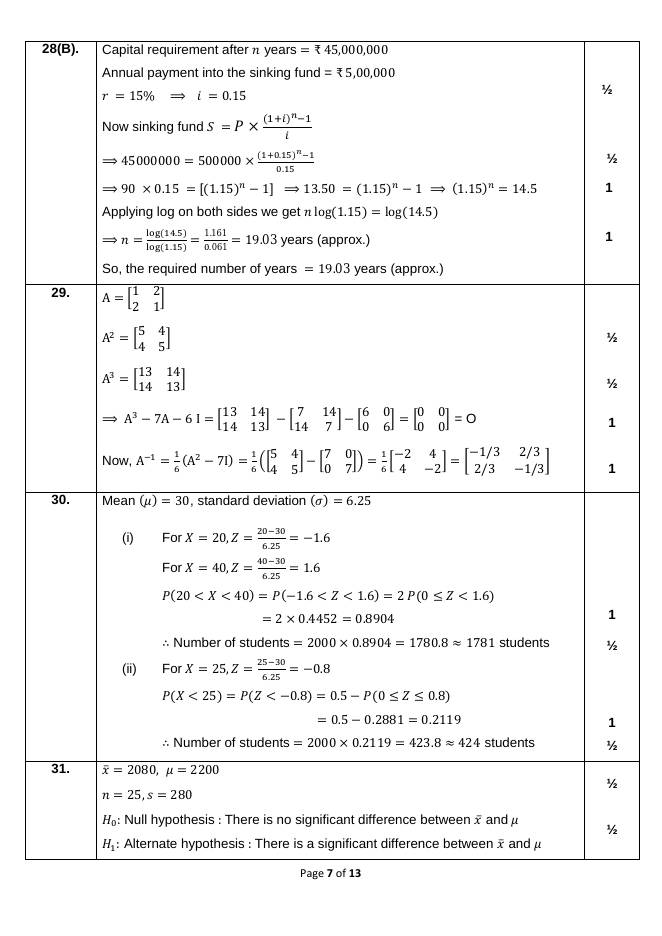
 28(B). A company needs to accumulate ₹ 45,000,000 in 𝑛 years to replace a fleet of
        vehicles. They decide to make annual deposits of ₹ 5,00,000 at the end of each
        year into a sinking fund. If the interest rate is 15% compounded annually, then in
        how many years will it take to reach the target?
        [Use log(14.5) = 1.161 and log(1.15) = 0.061]
Official CBSE answer and marking
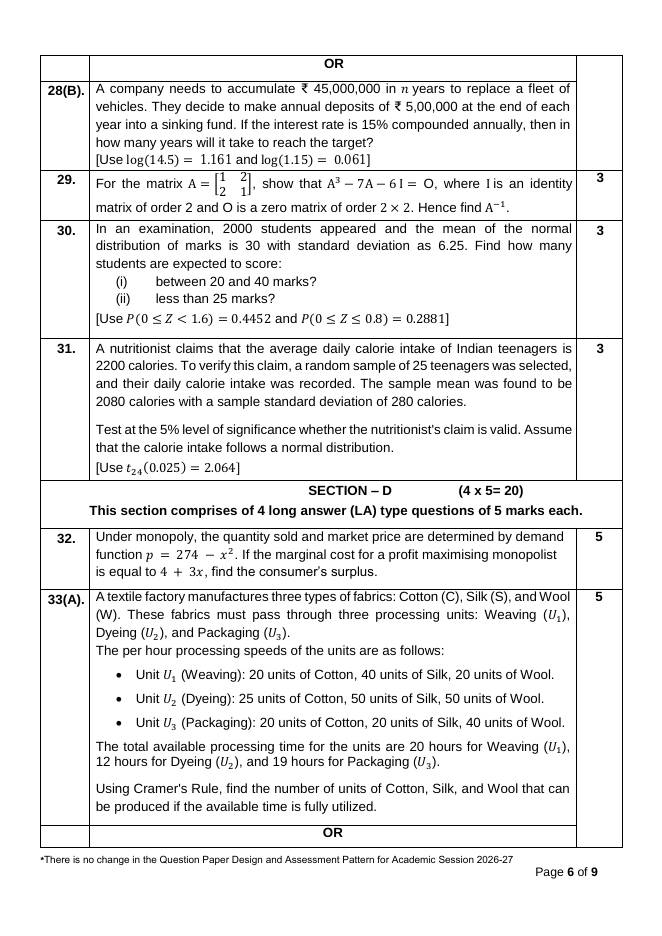
28(A).   Let PV of the share is ₹ 100 then final value = 100 + 0.331 × 100 = ₹133.10          ½
                              1
                  𝐹𝑉 𝑛
         CAGR = [(𝑃𝑉) − 1] × 100
                                  1
                                                                       1
                          133.10 𝑛
         ⟹ 8.5 = [( 100 ) − 1] × 100 ⟹ 8.5 = [(1.331)𝑛 − 1] × 100                             ½
                                      1
         ⟹ 1.085 = (1.331)𝑛
                                  1                               log(1.331)
         ⟹ log(1.085) = 𝑛 log(1.331)                ⟹𝑛 =                                      1
                                                                  log(1.085)
                      0.124
         ⟹𝑛=                  = 3.5 years (approx.)                                           1
                      0.035
         ∴ Required number of years = 3.5 years (approx.)
                                                            OR
28(B).   Capital requirement after 𝑛 years = ₹ 45,000,000
         Annual payment into the sinking fund = ₹ 5,00,000
         𝑟 = 15%         ⟹ 𝑖 = 0.15                                                       ½
                                          (1+𝑖)𝑛 −1
         Now sinking fund 𝑆 = 𝑃 ×
                                              𝑖
                                         (1+0.15)𝑛 −1
         ⟹ 45000000 = 500000 ×                                                            ½
                                             0.15
         ⟹ 90 × 0.15 = [(1.15)𝑛 − 1] ⟹ 13.50 = (1.15)𝑛 − 1 ⟹ (1.15)𝑛 = 14.5               1
         Applying log on both sides we get 𝑛 log(1.15) = log(14.5)
                    log(14.5)   1.161
         ⟹ 𝑛 = log(1.15) = 0.061 = 19.03 years (approx.)                                  1
         So, the required number of years = 19.03 years (approx.)
Independent verification noteQ28A: supplied logarithms give 0.124/0.035 = 3.542857..., rounded in the scheme to 3.5 years; do not describe 3.5 as exact. Q28B: the supplied logs give about 19.03 years, but deposits occur only at year end. Therefore 20 annual deposits, or 20 years, are needed to reach the target. With unrounded logs the algebraic time is about 19.1336; year 19 accumulates about ₹4,41,05,905 and year 20 about ₹5,12,21,791.Original pages for Question 28
 Motivation"Start where you are. Use what you have. Do what you can." : Arthur Ashe, TennisNow write it yourselfYou have read, listened and understood. Now close the answer, take a blank page and write and solve this question on your own, in proper CBSE format, with a timer running. Then check against the model answer. That effort will give you confidence for this type and similar types of questions.
- Question 293 marks
29.                         1 2                                                                                3
        For the matrix A = [        ], show that A3 − 7A − 6 I = O, where I is an identity
                              2 1
        matrix of order 2 and O is a zero matrix of order 2 × 2. Hence find A−1.
Official CBSE answer and marking
29. 1 2 A=[ ] 2 1 5 4 A2 = [ ] ½ 4 5 13 14 A3 = [ ] ½ 14 13 13 14 7 14 6 0 0 0 ⟹ A3 − 7A − 6 I = [ ] −[ ]−[ ]=[ ]=O 1 14 13 14 7 0 6 0 0 1 1 5 4 7 0 1 −2 4 −1/3 2/3 Now, A−1 = 6 (A2 − 7I) = 6 ([ ]−[ ]) = 6 [ ]=[ ] 4 5 0 7 4 −2 2/3 −1/3 1Original pages for Question 29
Motivation"The moment of victory is much too short to live for that and nothing else." : Martina Navratilova, TennisNow write it yourselfYou have read, listened and understood. Now close the answer, take a blank page and write and solve this question on your own, in proper CBSE format, with a timer running. Then check against the model answer. That effort will give you confidence for this type and similar types of questions. - Question 303 marks
30.     In an examination, 2000 students appeared and the mean of the normal                                  3
           distribution of marks is 30 with standard deviation as 6.25. Find how many
           students are expected to score:
               (i)    between 20 and 40 marks?
               (ii)   less than 25 marks?
           [Use 𝑃(0 ≤ 𝑍 < 1.6) = 0.4452 and 𝑃(0 ≤ 𝑍 ≤ 0.8) = 0.2881]
Official CBSE answer and marking
30. Mean (𝜇) = 30, standard deviation (𝜎) = 6.25 20−30 (i) For 𝑋 = 20, 𝑍 = 6.25 = −1.6 40−30 For 𝑋 = 40, 𝑍 = 6.25 = 1.6 𝑃(20 < 𝑋 < 40) = 𝑃(−1.6 < 𝑍 < 1.6) = 2 𝑃(0 ≤ 𝑍 < 1.6) = 2 × 0.4452 = 0.8904 1 ∴ Number of students = 2000 × 0.8904 = 1780.8 ≈ 1781 students ½ 25−30 (ii) For 𝑋 = 25, 𝑍 = 6.25 = −0.8 𝑃(𝑋 < 25) = 𝑃(𝑍 < −0.8) = 0.5 − 𝑃(0 ≤ 𝑍 ≤ 0.8) = 0.5 − 0.2881 = 0.2119 1 ∴ Number of students = 2000 × 0.2119 = 423.8 ≈ 424 students ½Original pages for Question 30
Motivation"Success is no accident. It is hard work, perseverance, learning, studying, sacrifice and most of all, love of what you are doing." : Pele, FootballNow write it yourselfYou have read, listened and understood. Now close the answer, take a blank page and write and solve this question on your own, in proper CBSE format, with a timer running. Then check against the model answer. That effort will give you confidence for this type and similar types of questions. - Question 313 marks
31.     A nutritionist claims that the average daily calorie intake of Indian teenagers is                    3
           2200 calories. To verify this claim, a random sample of 25 teenagers was selected,
           and their daily calorie intake was recorded. The sample mean was found to be
           2080 calories with a sample standard deviation of 280 calories.
           Test at the 5% level of significance whether the nutritionist's claim is valid. Assume
           that the calorie intake follows a normal distribution.
           [Use 𝑡24 (0.025) = 2.064]
Official CBSE answer and marking
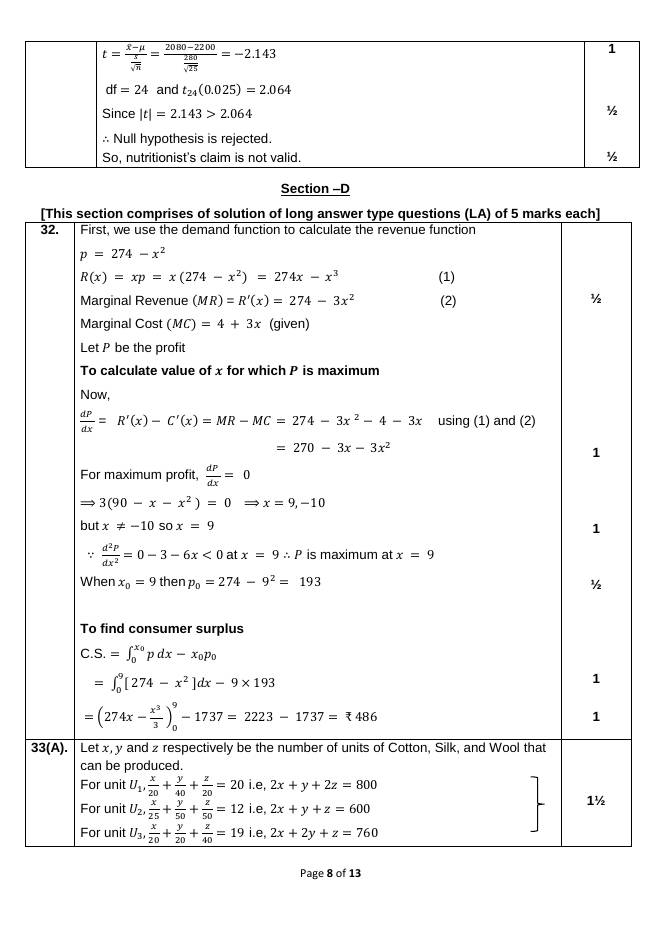
31. 𝑥̅ = 2080, 𝜇 = 2200 ½ 𝑛 = 25, 𝑠 = 280 𝐻0 : Null hypothesis : There is no significant difference between 𝑥̅ and 𝜇 ½ 𝐻1 : Alternate hypothesis : There is a significant difference between 𝑥̅ and 𝜇 𝑥̅ −𝜇 2080−2200 1 𝑡= 𝑠 = 280 = −2.143 √𝑛 √25 df = 24 and 𝑡24 (0.025) = 2.064 Since |𝑡| = 2.143 > 2.064 ½ ∴ Null hypothesis is rejected. So, nutritionist’s claim is not valid. ½Original pages for Question 31
 Motivation"Talent without working hard is nothing." : Cristiano Ronaldo, FootballNow write it yourselfYou have read, listened and understood. Now close the answer, take a blank page and write and solve this question on your own, in proper CBSE format, with a timer running. Then check against the model answer. That effort will give you confidence for this type and similar types of questions.
- Question 325 marks
32.     Under monopoly, the quantity sold and market price are determined by demand                           5
           function 𝑝 = 274 − 𝑥 2 . If the marginal cost for a profit maximising monopolist
           is equal to 4 + 3𝑥, find the consumer’s surplus.
Official CBSE answer and marking
32. First, we use the demand function to calculate the revenue function 𝑝 = 274 − 𝑥 2 𝑅(𝑥) = 𝑥𝑝 = 𝑥 (274 − 𝑥 2 ) = 274𝑥 − 𝑥 3 (1) Marginal Revenue (𝑀𝑅) = 𝑅 ′ (𝑥) = 274 − 3𝑥 2 (2) ½ Marginal Cost (𝑀𝐶) = 4 + 3𝑥 (given) Let 𝑃 be the profit To calculate value of 𝒙 for which 𝑷 is maximum Now, 𝑑𝑃 = 𝑅 ′ (𝑥) − 𝐶 ′ (𝑥) = 𝑀𝑅 − 𝑀𝐶 = 274 − 3𝑥 2 − 4 − 3𝑥 using (1) and (2) 𝑑𝑥 = 270 − 3𝑥 − 3𝑥 2 1 𝑑𝑃 For maximum profit, 𝑑𝑥 = 0 ⟹ 3(90 − 𝑥 − 𝑥 2 ) = 0 ⟹ 𝑥 = 9, −10 but 𝑥 ≠ −10 so 𝑥 = 9 1 𝑑2 𝑃 ∵ 𝑑𝑥 2 = 0 − 3 − 6𝑥 < 0 at 𝑥 = 9 ∴ 𝑃 is maximum at 𝑥 = 9 When 𝑥0 = 9 then 𝑝0 = 274 − 92 = 193 ½ To find consumer surplus 𝑥 C.S. = ∫0 0 𝑝 𝑑𝑥 − 𝑥0 𝑝0 9 1 = ∫0 [ 274 − 𝑥 2 ]𝑑𝑥 − 9 × 193 9 𝑥3 = (274𝑥 − 3 ) − 1737 = 2223 − 1737 = ₹ 486 1 0Original pages for Question 32
Motivation"You have to fight to reach your dream. You have to sacrifice and work hard for it." : Lionel Messi, Football (attributed)Now write it yourselfYou have read, listened and understood. Now close the answer, take a blank page and write and solve this question on your own, in proper CBSE format, with a timer running. Then check against the model answer. That effort will give you confidence for this type and similar types of questions. - Question 335 marks
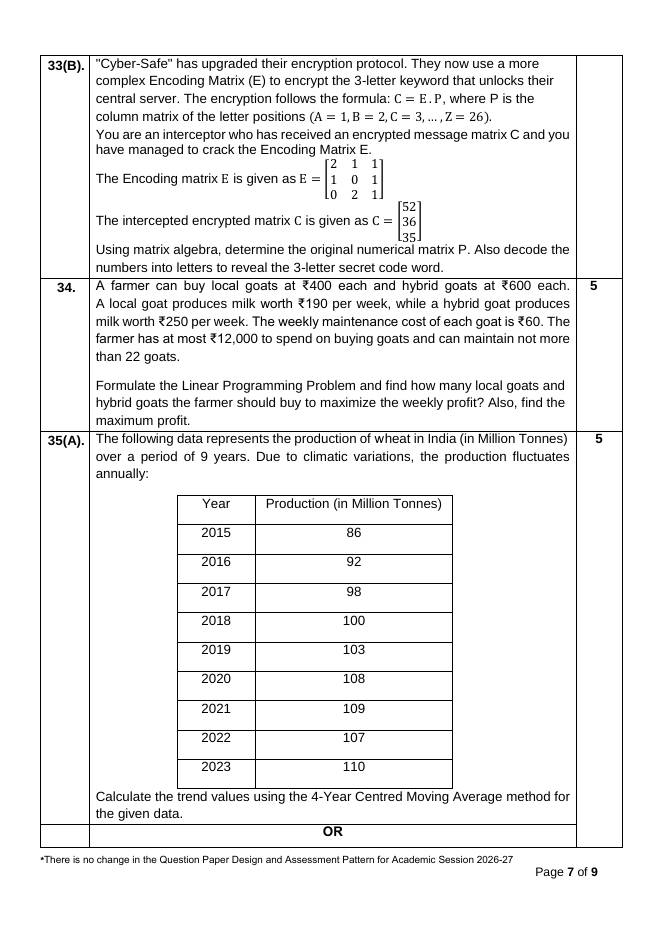
33(A). A textile factory manufactures three types of fabrics: Cotton (C), Silk (S), and Wool 5 (W). These fabrics must pass through three processing units: Weaving (𝑈1 ), Dyeing (𝑈2 ), and Packaging (𝑈3 ). The per hour processing speeds of the units are as follows: Unit 𝑈1 (Weaving): 20 units of Cotton, 40 units of Silk, 20 units of Wool. Unit 𝑈2 (Dyeing): 25 units of Cotton, 50 units of Silk, 50 units of Wool. Unit 𝑈3 (Packaging): 20 units of Cotton, 20 units of Silk, 40 units of Wool. The total available processing time for the units are 20 hours for Weaving (𝑈1 ), 12 hours for Dyeing (𝑈2 ), and 19 hours for Packaging (𝑈3 ). Using Cramer's Rule, find the number of units of Cotton, Silk, and Wool that can be produced if the available time is fully utilized. OR *There is no change in the Question Paper Design and Assessment Pattern for Academic Session 2026-27 33(B). "Cyber-Safe" has upgraded their encryption protocol. They now use a more complex Encoding Matrix (E) to encrypt the 3-letter keyword that unlocks their central server. The encryption follows the formula: C = E . P, where P is the column matrix of the letter positions (A = 1, B = 2, C = 3, … , Z = 26). You are an interceptor who has received an encrypted message matrix C and you have managed to crack the Encoding Matrix E. 2 1 1 The Encoding matrix E is given as E = [1 0 1] 0 2 1 52 The intercepted encrypted matrix C is given as C = [36] 35 Using matrix algebra, determine the original numerical matrix P. Also decode the numbers into letters to reveal the 3-letter secret code word.Official CBSE answer and marking
33(A). Let 𝑥, 𝑦 and 𝑧 respectively be the number of units of Cotton, Silk, and Wool that can be produced. 𝑥 𝑦 𝑧 For unit 𝑈1 , 20 + 40 + 20 = 20 i.e, 2𝑥 + 𝑦 + 2𝑧 = 800 𝑥 𝑦 𝑧 1½ For unit 𝑈2 , 25 + 50 + 50 = 12 i.e, 2𝑥 + 𝑦 + 𝑧 = 600 𝑥 𝑦 𝑧 For unit 𝑈3 , 20 + 20 + 40 = 19 i.e, 2𝑥 + 2𝑦 + 𝑧 = 760 2 1 2 Now, 𝐷 = |2 1 1| = 2(1 − 2) − 1(2 − 2) + 2(4 − 2) = 2 ≠ 0 2 2 1 ½ 800 1 2 𝐷𝑥 = |600 1 1| = 800(1 − 2) − 1(600 − 760) + 2(1200 − 760) = 240 760 2 1 2 800 2 ½ 𝐷𝑦 = |2 600 1| = 2(600 − 760) − 800(2 − 2) + 2(1520 − 1200) = 320 2 760 1 ½ 2 1 800 𝐷𝑧 = |2 1 600| = 2(760 − 1200) − 1(1520 − 1200) + 800(4 − 2) = 400 2 2 760 ½ 𝐷 𝐷𝑦 𝐷 ∴ 𝑥 = 𝐷𝑥 = 120, 𝑦 = 𝐷 = 160 and 𝑧 = 𝐷𝑧 = 200 1/2 Hence, the firm can produce 120 units of Cotton, 160 units of Silk, and 200 units of Wool with the available time fully used. 1 OR 33(B). 2 1 1 52 x P = E −1 . C , where E = [1 0 1] , C = [36] and let P = [y] ½ 0 2 1 35 z |E| = 2(0 − 2) − 1(1 − 0) + 1(2 − 0) = −3 ≠ 0 ∴ E −1 exists ½ −2 1 1 −2 1 1 1 1 E −1 = |E| [−1 2 −1] = −3 [−1 2 −1] 1 2 −4 −1 2 −4 −1 x −2 1 1 52 −33 1 1 ⟹ P = [y] = −3 [−1 2 −1] [36] = −3 [−15] 1 z 2 −4 −1 35 −75 ⟹ x = 11, y = 5, z = 25 1½ Now, 11 → K, 5 → E, 25 → Y So, the secret code word is ‘KEY’ ½Original pages for Question 33
 Motivation"The vision of a champion is someone who is bent over, drenched in sweat, at the point of exhaustion, when no one else is watching." : Mia Hamm, FootballNow write it yourselfYou have read, listened and understood. Now close the answer, take a blank page and write and solve this question on your own, in proper CBSE format, with a timer running. Then check against the model answer. That effort will give you confidence for this type and similar types of questions.
- Question 345 marks
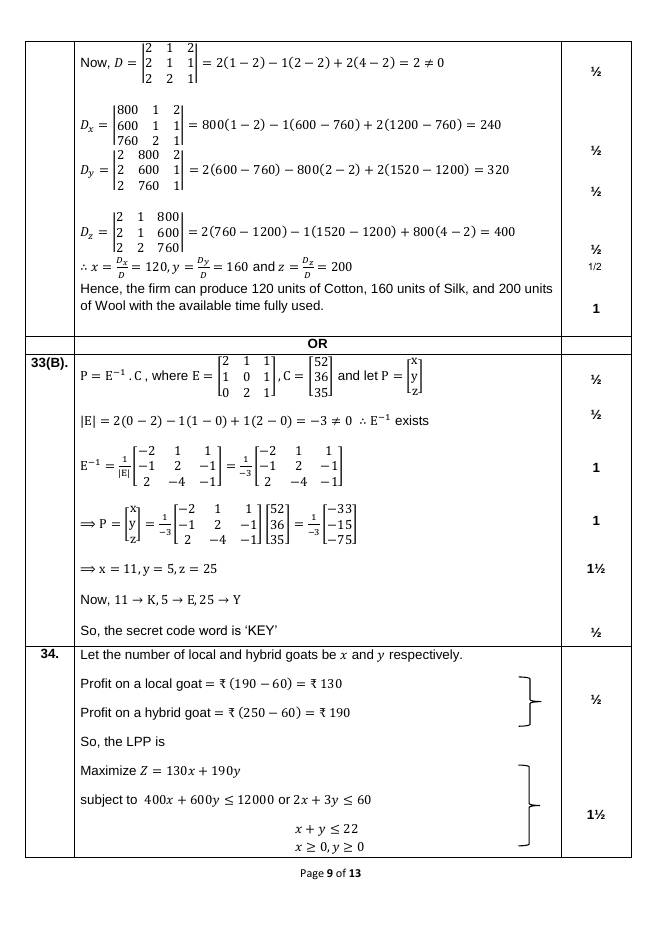
34.   A farmer can buy local goats at ₹400 each and hybrid goats at ₹600 each.                                5
        A local goat produces milk worth ₹190 per week, while a hybrid goat produces
        milk worth ₹250 per week. The weekly maintenance cost of each goat is ₹60. The
        farmer has at most ₹12,000 to spend on buying goats and can maintain not more
        than 22 goats.
        Formulate the Linear Programming Problem and find how many local goats and
        hybrid goats the farmer should buy to maximize the weekly profit? Also, find the
        maximum profit.
Official CBSE answer and marking
34. Let the number of local and hybrid goats be 𝑥 and 𝑦 respectively. Profit on a local goat = ₹ (190 − 60) = ₹ 130 ½ Profit on a hybrid goat = ₹ (250 − 60) = ₹ 190 So, the LPP is Maximize 𝑍 = 130𝑥 + 190𝑦 subject to 400𝑥 + 600𝑦 ≤ 12000 or 2𝑥 + 3𝑦 ≤ 60 1½ 𝑥 + 𝑦 ≤ 22 𝑥 ≥ 0, 𝑦 ≥ 0 2 for correct graph Corner Points Value of 𝑍 1 for correct O (0,0) 0 table A (22,0) 2860 B (0,20) 3800 Maximum value C (6, 16) 3820 Hence the maximum weekly profit of ₹ 3,820 is obtained when the farmer buys 6 local goats and 16 hybrid goats.Original pages for Question 34
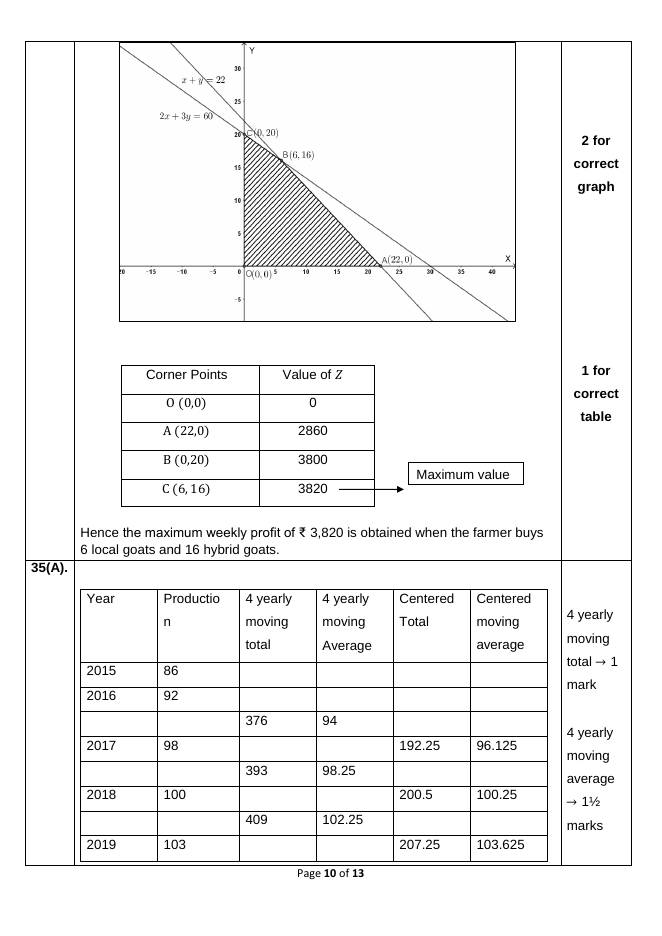 Motivation"It is hard to beat a person who never gives up." : Babe Ruth, BaseballNow write it yourselfYou have read, listened and understood. Now close the answer, take a blank page and write and solve this question on your own, in proper CBSE format, with a timer running. Then check against the model answer. That effort will give you confidence for this type and similar types of questions.
- Question 355 marks
35(A). The following data represents the production of wheat in India (in Million Tonnes)                       5
        over a period of 9 years. Due to climatic variations, the production fluctuates
        annually:
                                  Year         Production (in Million Tonnes)
                                 2015                           86
                                 2016                           92
                                 2017                           98
                                 2018                          100
                                 2019                          103
                                 2020                          108
                                 2021                          109
                                 2022                          107
                                 2023                          110
           Calculate the trend values using the 4-Year Centred Moving Average method for
           the given data.
                                                  OR
*There is no change in the Question Paper Design and Assessment Pattern for Academic Session 2026-27
 35(B). The "Digital India" initiative has led to a massive surge in digital payment
        transactions across the country. The following data represents the volume of
        digital transactions (UPI, NEFT, IMPS, debit card etc.) in India (in Crores) for 6
        consecutive years. The growth has been significant due to the push for a digital
        economy.
               Year        2018         2019        2020      2021        2022       2023
                 Volume (in      2071          3134          4572          5554         8839           13462
                  crores)
           (i)  Fit a straight-line trend to the above data using the method of Least
                Squares.
           (ii) Estimate the likely volume of transactions for the year 2025, assuming the
                current trend continues.
Official CBSE answer and marking
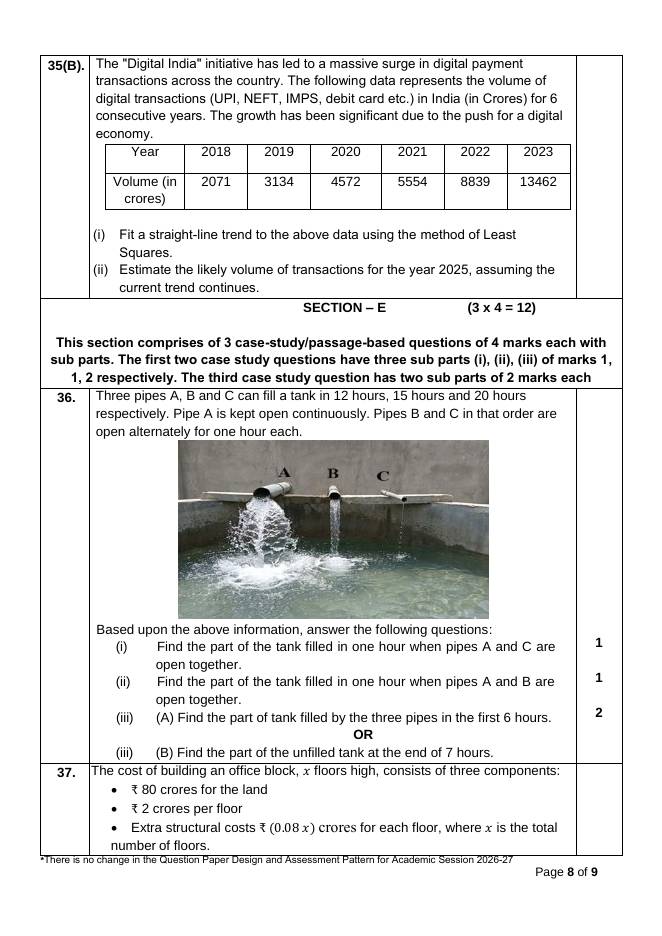
35(A).
          Year        Productio    4 yearly         4 yearly   Centered   Centered
                      n            moving           moving     Total      moving       4 yearly
                                   total                                  average      moving
                                                    Average
                                                                                       total → 1
          2015        86
                                                                                       mark
          2016        92
                                   376              94
                                                                                       4 yearly
          2017        98                                       192.25     96.125
                                                                                       moving
                                   393              98.25
                                                                                       average
          2018        100                                      200.5      100.25
                                                                                       → 1½
                                   409              102.25                             marks
          2019        103                                      207.25     103.625
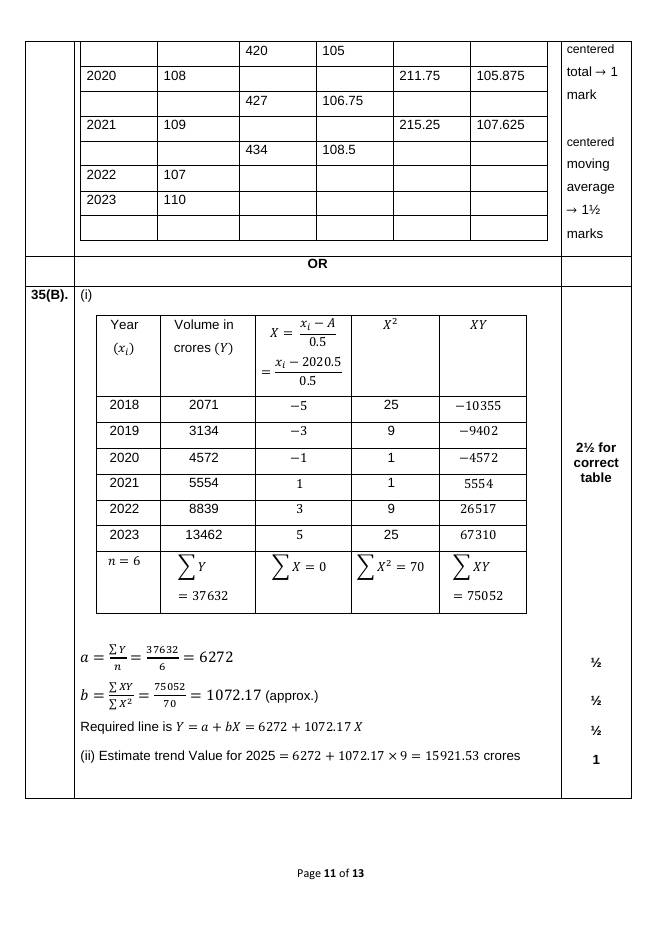
                                          420             105                                   centered
         2020             108                                             211.75      105.875   total → 1
                                          427             106.75                                mark
         2021             109                                             215.25      107.625
                                                                                                centered
                                          434             108.5
                                                                                                moving
         2022             107
                                                                                                average
         2023             110
                                                                                                → 1½
                                                                                                marks
                                                         OR
35(B). (i)
             Year            Volume in            𝑥𝑖 − 𝐴             𝑋2              𝑋𝑌
                                                𝑋=
             (𝑥𝑖 )           crores (𝑌)             0.5
                                              𝑥𝑖 − 2020.5
                                            =
                                                  0.5
             2018                2071             −5                 25            −10355
             2019                3134             −3                  9            −9402
                                                                                                 2½ for
             2020                4572             −1                  1            −4572         correct
             2021                5554                1                1             5554          table
             2022                8839                3                9            26517
             2023               13462                5               25            67310
             𝑛=6               ∑𝑌               ∑𝑋 = 0            ∑ 𝑋 2 = 70       ∑ 𝑋𝑌
                               = 37632                                             = 75052
             ∑𝑌         37632
        𝑎=          =           = 6272                                                              ½
             𝑛           6
             ∑ 𝑋𝑌        75052
        𝑏=∑ 2=                   = 1072.17 (approx.)                                                ½
                𝑋         70
        Required line is 𝑌 = 𝑎 + 𝑏𝑋 = 6272 + 1072.17 𝑋                                              ½
        (ii) Estimate trend Value for 2025 = 6272 + 1072.17 × 9 = 15921.53 crores                   1
Independent verification noteFor Q35B, retaining the exact least-squares coefficient gives the 2025 estimate 15,921.54 crore transactions. The scheme's 15,921.53 crore transactions follows early coefficient rounding. These are transaction counts, not rupee amounts.Original pages for Question 35
 Motivation"My motto was always to keep swinging." : Hank Aaron, BaseballNow write it yourselfYou have read, listened and understood. Now close the answer, take a blank page and write and solve this question on your own, in proper CBSE format, with a timer running. Then check against the model answer. That effort will give you confidence for this type and similar types of questions.
- Question 364 marks
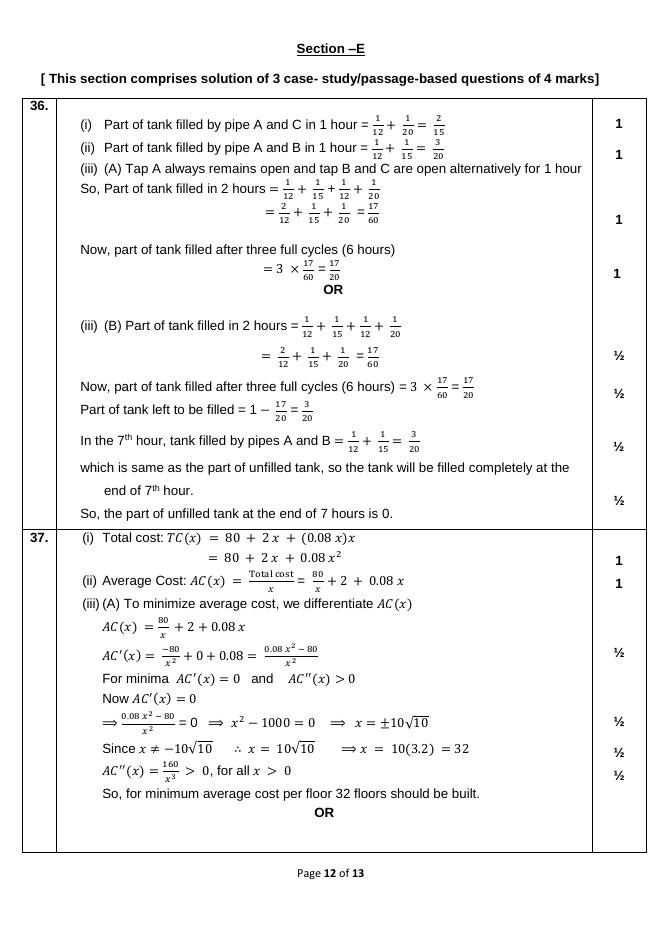
36.    Three pipes A, B and C can fill a tank in 12 hours, 15 hours and 20 hours
          respectively. Pipe A is kept open continuously. Pipes B and C in that order are
          open alternately for one hour each.
           Based upon the above information, answer the following questions:
              (i)    Find the part of the tank filled in one hour when pipes A and C are                           1
                     open together.
              (ii)   Find the part of the tank filled in one hour when pipes A and B are                           1
                     open together.
              (iii)  (A) Find the part of tank filled by the three pipes in the first 6 hours.                     2
                                                          OR
              (iii)  (B) Find the part of the unfilled tank at the end of 7 hours.
Official CBSE answer and marking
36. 1 1 2 (i) Part of tank filled by pipe A and C in 1 hour = 12 + 20 = 15 1 1 1 3 (ii) Part of tank filled by pipe A and B in 1 hour = 12 + 15 = 20 1 (iii) (A) Tap A always remains open and tap B and C are open alternatively for 1 hour 1 1 1 1 So, Part of tank filled in 2 hours = 12 + 15 + 12 + 20 2 1 1 17 = 12 + 15 + 20 = 60 1 Now, part of tank filled after three full cycles (6 hours) 17 17 = 3 × 60 = 20 1 OR 1 1 1 1 (iii) (B) Part of tank filled in 2 hours = 12 + 15 + 12 + 20 2 1 1 17 = 12 + 15 + 20 = 60 ½ 17 17 Now, part of tank filled after three full cycles (6 hours) = 3 × 60 = 20 ½ 17 3 Part of tank left to be filled = 1 − 20 = 20 1 1 3 In the 7th hour, tank filled by pipes A and B = 12 + 15 = 20 ½ which is same as the part of unfilled tank, so the tank will be filled completely at the end of 7th hour. ½ So, the part of unfilled tank at the end of 7 hours is 0.Original pages for Question 36
 Motivation"A life is not important except in the impact it has on other lives." : Jackie Robinson, BaseballNow write it yourselfYou have read, listened and understood. Now close the answer, take a blank page and write and solve this question on your own, in proper CBSE format, with a timer running. Then check against the model answer. That effort will give you confidence for this type and similar types of questions.
- Question 374 marks
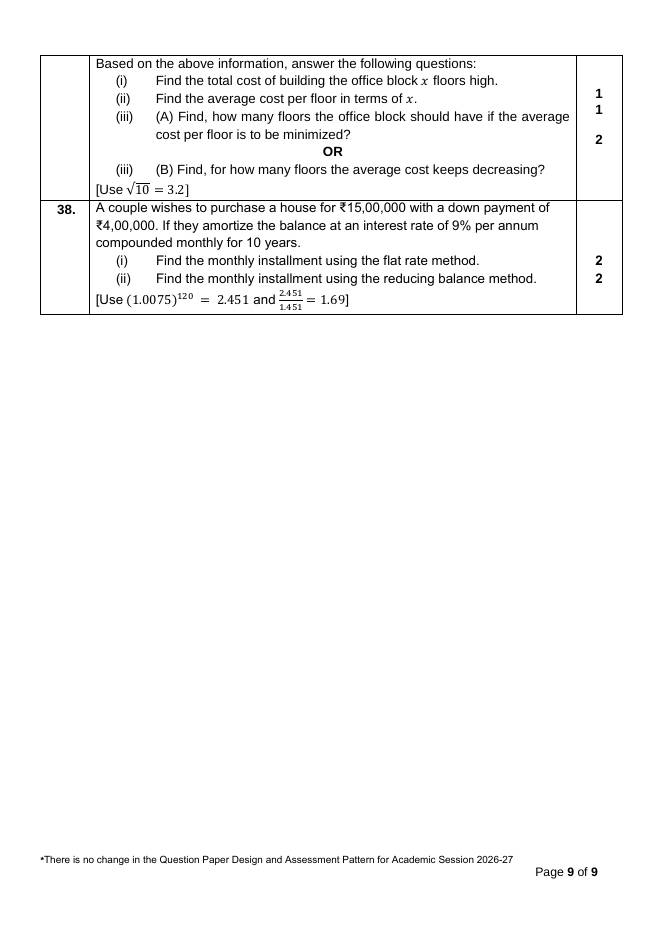
37. The cost of building an office block, 𝑥 floors high, consists of three components: ₹ 80 crores for the land ₹ 2 crores per floor Extra structural costs ₹ (0.08 𝑥) crores for each floor, where 𝑥 is the total number of floors. *There is no change in the Question Paper Design and Assessment Pattern for Academic Session 2026-27 Based on the above information, answer the following questions: (i) Find the total cost of building the office block 𝑥 floors high. (ii) Find the average cost per floor in terms of 𝑥. 1 1 (iii) (A) Find, how many floors the office block should have if the average cost per floor is to be minimized? 2 OR (iii) (B) Find, for how many floors the average cost keeps decreasing? [Use √10 = 3.2]Official CBSE answer and marking
37.    (i) Total cost: 𝑇𝐶(𝑥) = 80 + 2 𝑥 + (0.08 𝑥)𝑥
                             = 80 + 2 𝑥 + 0.08 𝑥 2                                                               1
                                         Total cost          80
       (ii) Average Cost: 𝐴𝐶(𝑥) =                      =          + 2 + 0.08 𝑥                                   1
                                             𝑥               𝑥
       (iii) (A) To minimize average cost, we differentiate 𝐴𝐶(𝑥)
                         80
           𝐴𝐶(𝑥) = 𝑥 + 2 + 0.08 𝑥
                         −80                0.08 𝑥 2 − 80
           𝐴𝐶 ′ (𝑥) =        + 0 + 0.08 =                                                                        ½
                          𝑥2                      𝑥2
           For minima 𝐴𝐶 ′ (𝑥) = 0 and                𝐴𝐶 ′′ (𝑥) > 0
           Now 𝐴𝐶 ′ (𝑥) = 0
               0.08 𝑥 2 − 80
           ⟹                   = 0 ⟹ 𝑥 2 − 1000 = 0               ⟹ 𝑥 = ±10√10                                   ½
                    𝑥2
           Since 𝑥 ≠ −10√10            ∴ 𝑥 = 10√10                     ⟹ 𝑥 = 10(3.2) = 32                        ½
               ′′        160
           𝐴𝐶 (𝑥) = 𝑥 3 > 0, for all 𝑥 > 0                                                                       ½
           So, for minimum average cost per floor 32 floors should be built.
                                              OR
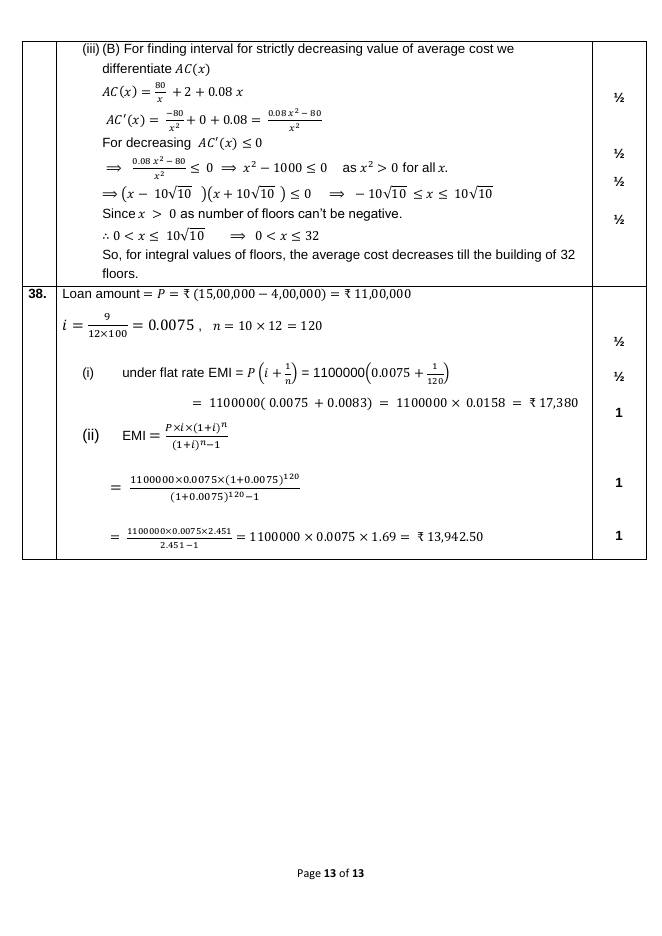
         (iii) (B) For finding interval for strictly decreasing value of average cost we
               differentiate 𝐴𝐶(𝑥)
                           80
                𝐴𝐶(𝑥) = 𝑥 + 2 + 0.08 𝑥                                                              ½
                                −80                  0.08 𝑥 2 − 80
                𝐴𝐶 ′ (𝑥) =            + 0 + 0.08 =
                                𝑥2                        𝑥2
                For decreasing 𝐴𝐶 ′ (𝑥) ≤ 0
                                                                                                    ½
                      0.08 𝑥 2 − 80
                ⟹                     ≤ 0 ⟹ 𝑥 2 − 1000 ≤ 0            as 𝑥 2 > 0 for all 𝑥.
                           𝑥2
                                                                                                    ½
                ⟹ (𝑥 − 10√10 )(𝑥 + 10√10 ) ≤ 0                       ⟹ − 10√10 ≤ 𝑥 ≤ 10√10
                Since 𝑥 > 0 as number of floors can’t be negative.                                  ½
            ∴ 0 < 𝑥 ≤ 10√10        ⟹ 0 < 𝑥 ≤ 32
            So, for integral values of floors, the average cost decreases till the building of 32
            floors.
Independent verification noteQ37(iii)B: the continuous decreasing interval is 0 < x < 10√10, with its minimum at 10√10. The exact derivative is not negative at 32. The integer-floor minimum is nevertheless 32 floors.Original pages for Question 37
 Motivation"You miss 100% of the shots you do not take." : Wayne Gretzky, Ice HockeyNow write it yourselfYou have read, listened and understood. Now close the answer, take a blank page and write and solve this question on your own, in proper CBSE format, with a timer running. Then check against the model answer. That effort will give you confidence for this type and similar types of questions.
- Question 384 marks
38.     A couple wishes to purchase a house for ₹15,00,000 with a down payment of
           ₹4,00,000. If they amortize the balance at an interest rate of 9% per annum
           compounded monthly for 10 years.
              (i)   Find the monthly installment using the flat rate method.                                     2
              (ii)  Find the monthly installment using the reducing balance method.                              2
                                                  2.451
           [Use (1.0075)120 = 2.451 and 1.451 = 1.69]
*There is no change in the Question Paper Design and Assessment Pattern for Academic Session 2026-27
Official CBSE answer and marking
38.   Loan amount = 𝑃 = ₹ (15,00,000 − 4,00,000) = ₹ 11,00,000
                9
      𝑖=              = 0.0075 , 𝑛 = 10 × 12 = 120
           12×100
                                                                                                    ½
                                                         1                             1
         (i)         under flat rate EMI = 𝑃 (𝑖 + 𝑛) = 1100000(0.0075 + 120)                        ½
                                      = 1100000( 0.0075 + 0.0083) = 1100000 × 0.0158 = ₹ 17,380
                                                                                                    1
                                𝑃×𝑖×(1+𝑖)𝑛
         (ii)        EMI =
                                 (1+𝑖)𝑛 −1
                      1100000×0.0075×(1+0.0075)120                                                  1
                 =
                                (1+0.0075)120 −1
                     1100000×0.0075×2.451
                 =                           = 1100000 × 0.0075 × 1.69 = ₹ 13,942.50                1
                             2.451 −1
Independent verification noteIndependent correction to Q38(i): flat-rate monthly instalment = ₹11,00,000 × (0.0075 + 1/120) = ₹17,416.67, not ₹17,380 from prematurely rounding 1/120 to 0.0083. Q38(ii): ₹13,942.50 is valid using the question's supplied ratio 1.69; without that approximation the reducing-balance EMI is about ₹13,934.34.Original pages for Question 38
Motivation"Practice does not make perfect. Only perfect practice makes perfect." : Vince Lombardi, American FootballNow write it yourselfYou have read, listened and understood. Now close the answer, take a blank page and write and solve this question on your own, in proper CBSE format, with a timer running. Then check against the model answer. That effort will give you confidence for this type and similar types of questions.
Original CBSE pages (question paper and marking scheme)