
Accountancy (055) Sample Question Paper 2026-27: Fully Solved
Official CBSE paper · 34 questions · Theory 80 marks · 3 hours
Note
Questions and answers below are extracted from the official CBSE PDFs published on cbseacademic.nic.in. Plain-text extraction may lose mathematical layout, tables or diagrams; consult the original pages linked beside each question. Source discrepancies are identified separately.
Tip
Questions 27 to 34 show both Part B options separately. Attempt only the option your school follows.
Marks shown per question follow the paper's general instructions and add up to 80 per option.
- Question 11 mark
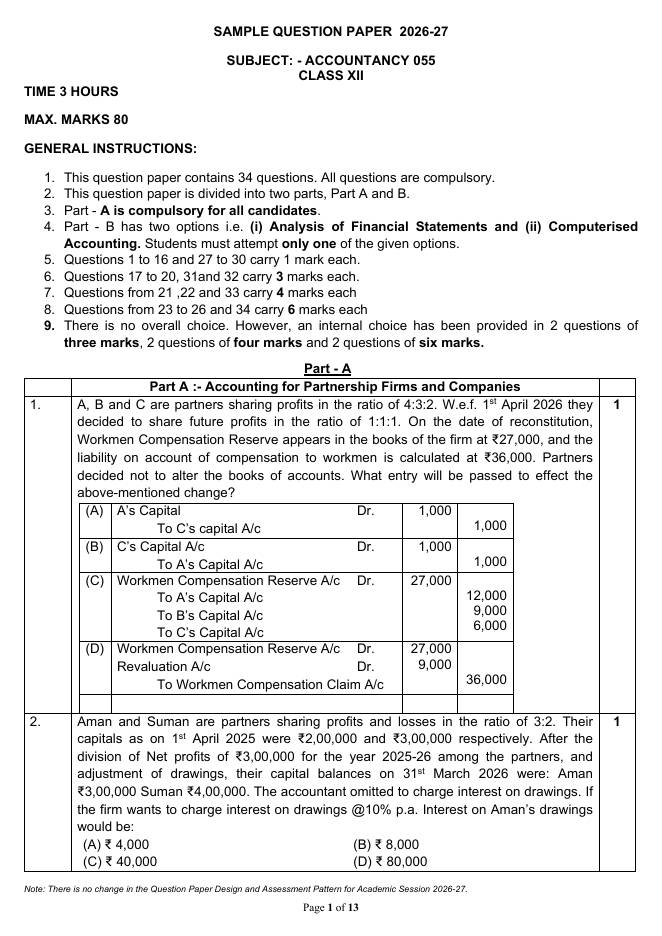
1.         A, B and C are partners sharing profits in the ratio of 4:3:2. W.e.f. 1st April 2026 they        1
            decided to share future profits in the ratio of 1:1:1. On the date of reconstitution,
            Workmen Compensation Reserve appears in the books of the firm at ₹27,000, and the
            liability on account of compensation to workmen is calculated at ₹36,000. Partners
            decided not to alter the books of accounts. What entry will be passed to effect the
            above-mentioned change?
              (A) A’s Capital                               Dr.       1,000
                           To C’s capital A/c                                   1,000
              (B) C’s Capital A/c                           Dr.       1,000
                           To A’s Capital A/c                                   1,000
              (C) Workmen Compensation Reserve A/c Dr.               27,000
                           To A’s Capital A/c                                 12,000
                           To B’s Capital A/c                                   9,000
                                                                                6,000
                           To C’s Capital A/c
              (D) Workmen Compensation Reserve A/c Dr.               27,000
                     Revaluation A/c                        Dr.       9,000
                           To Workmen Compensation Claim A/c                  36,000
Official CBSE answer and marking
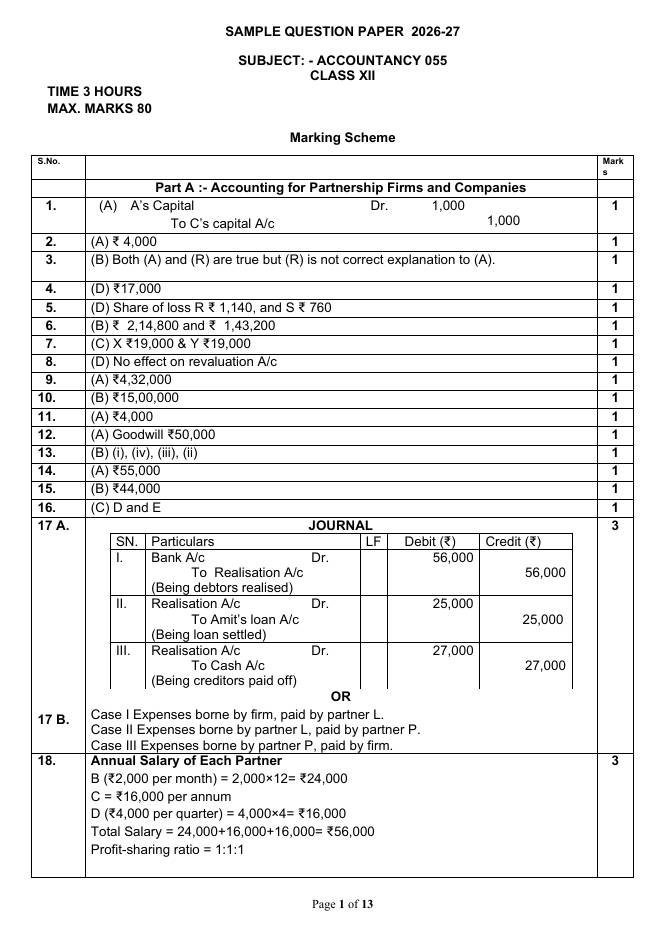
1. (A) A’s Capital Dr. 1,000 1 To C’s capital A/c 1,000Original pages for Question 1
 Motivation"Strength does not come from physical capacity. It comes from an indomitable will." : Mahatma GandhiNow write it yourselfYou have read, listened and understood. Now close the answer, take a blank page and write and solve this question on your own, in proper CBSE format, with a timer running. Then check against the model answer. That effort will give you confidence for this type and similar types of questions.
- Question 21 mark
2.         Aman and Suman are partners sharing profits and losses in the ratio of 3:2. Their                1
            capitals as on 1st April 2025 were ₹2,00,000 and ₹3,00,000 respectively. After the
            division of Net profits of ₹3,00,000 for the year 2025-26 among the partners, and
            adjustment of drawings, their capital balances on 31st March 2026 were: Aman
            ₹3,00,000 Suman ₹4,00,000. The accountant omitted to charge interest on drawings. If
            the firm wants to charge interest on drawings @10% p.a. Interest on Aman’s drawings
            would be:
             (A) ₹ 4,000                                  (B) ₹ 8,000
             (C) ₹ 40,000                                 (D) ₹ 80,000
Official CBSE answer and marking
2. (A) ₹ 4,000 1Independent verification noteThe official ₹4,000 assumes ₹80,000 drawings spread evenly through the year, giving six months' average interest. Dates are not supplied, so the precise interest otherwise depends on timing.Original pages for Question 2
Motivation"The future depends on what you do today." : Mahatma Gandhi (attributed)Now write it yourselfYou have read, listened and understood. Now close the answer, take a blank page and write and solve this question on your own, in proper CBSE format, with a timer running. Then check against the model answer. That effort will give you confidence for this type and similar types of questions. - Question 31 mark
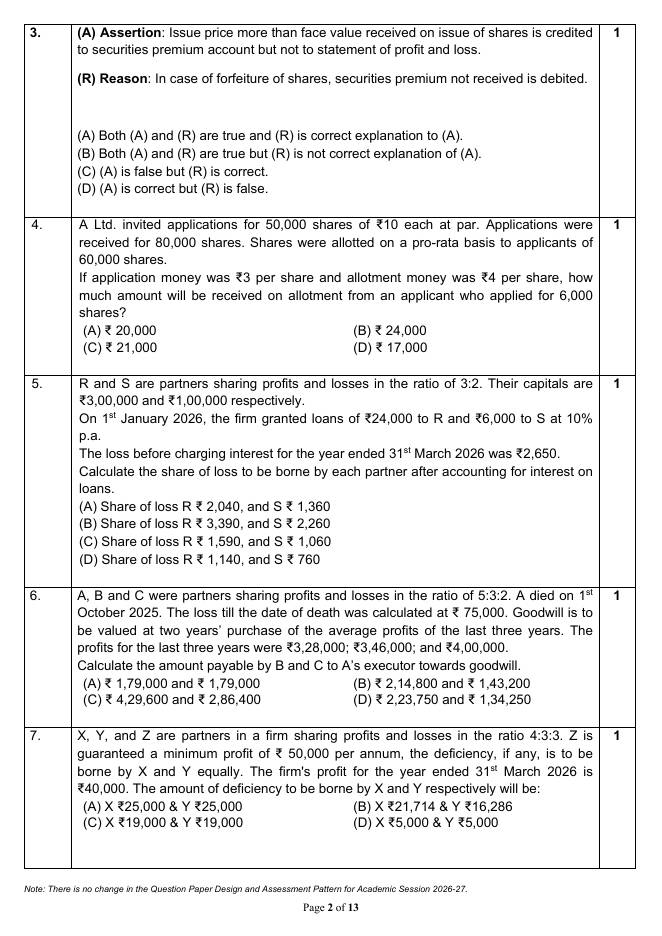
3.         (A) Assertion: Issue price more than face value received on issue of shares is credited          1
            to securities premium account but not to statement of profit and loss.
            (R) Reason: In case of forfeiture of shares, securities premium not received is debited.
            (A) Both (A) and (R) are true and (R) is correct explanation to (A).
            (B) Both (A) and (R) are true but (R) is not correct explanation of (A).
            (C) (A) is false but (R) is correct.
            (D) (A) is correct but (R) is false.
Official CBSE answer and marking
3. (B) Both (A) and (R) are true but (R) is not correct explanation to (A). 1Original pages for Question 3
 Motivation"Where the mind is without fear and the head is held high, where knowledge is free." : Rabindranath TagoreNow write it yourselfYou have read, listened and understood. Now close the answer, take a blank page and write and solve this question on your own, in proper CBSE format, with a timer running. Then check against the model answer. That effort will give you confidence for this type and similar types of questions.
- Question 41 mark
4.          A Ltd. invited applications for 50,000 shares of ₹10 each at par. Applications were             1
             received for 80,000 shares. Shares were allotted on a pro-rata basis to applicants of
             60,000 shares.
             If application money was ₹3 per share and allotment money was ₹4 per share, how
             much amount will be received on allotment from an applicant who applied for 6,000
             shares?
              (A) ₹ 20,000                                (B) ₹ 24,000
              (C) ₹ 21,000                                (D) ₹ 17,000
Official CBSE answer and marking
4. (D) ₹17,000 1Original pages for Question 4
Motivation"Become capable, and success will chase you." : 3 Idiots (2009 film)Now write it yourselfYou have read, listened and understood. Now close the answer, take a blank page and write and solve this question on your own, in proper CBSE format, with a timer running. Then check against the model answer. That effort will give you confidence for this type and similar types of questions. - Question 51 mark
5.          R and S are partners sharing profits and losses in the ratio of 3:2. Their capitals are         1
             ₹3,00,000 and ₹1,00,000 respectively.
             On 1st January 2026, the firm granted loans of ₹24,000 to R and ₹6,000 to S at 10%
             p.a.
             The loss before charging interest for the year ended 31st March 2026 was ₹2,650.
             Calculate the share of loss to be borne by each partner after accounting for interest on
             loans.
             (A) Share of loss R ₹ 2,040, and S ₹ 1,360
             (B) Share of loss R ₹ 3,390, and S ₹ 2,260
             (C) Share of loss R ₹ 1,590, and S ₹ 1,060
             (D) Share of loss R ₹ 1,140, and S ₹ 760
Official CBSE answer and marking
5. (D) Share of loss R ₹ 1,140, and S ₹ 760 1Original pages for Question 5
Motivation"Cultivate the habit of being grateful for every good thing that comes to you." : Ramakrishna Paramahamsa (attributed)Now write it yourselfYou have read, listened and understood. Now close the answer, take a blank page and write and solve this question on your own, in proper CBSE format, with a timer running. Then check against the model answer. That effort will give you confidence for this type and similar types of questions. - Question 61 mark
6.         A, B and C were partners sharing profits and losses in the ratio of 5:3:2. A died on 1st         1
            October 2025. The loss till the date of death was calculated at ₹ 75,000. Goodwill is to
            be valued at two years’ purchase of the average profits of the last three years. The
            profits for the last three years were ₹3,28,000; ₹3,46,000; and ₹4,00,000.
            Calculate the amount payable by B and C to A’s executor towards goodwill.
             (A) ₹ 1,79,000 and ₹ 1,79,000                   (B) ₹ 2,14,800 and ₹ 1,43,200
             (C) ₹ 4,29,600 and ₹ 2,86,400                   (D) ₹ 2,23,750 and ₹ 1,34,250
Official CBSE answer and marking
6. (B) ₹ 2,14,800 and ₹ 1,43,200 1Original pages for Question 6
Motivation"Education is the most powerful weapon which you can use to change the world." : Nelson MandelaNow write it yourselfYou have read, listened and understood. Now close the answer, take a blank page and write and solve this question on your own, in proper CBSE format, with a timer running. Then check against the model answer. That effort will give you confidence for this type and similar types of questions. - Question 71 mark
7.         X, Y, and Z are partners in a firm sharing profits and losses in the ratio 4:3:3. Z is           1
            guaranteed a minimum profit of ₹ 50,000 per annum, the deficiency, if any, is to be
            borne by X and Y equally. The firm's profit for the year ended 31st March 2026 is
            ₹40,000. The amount of deficiency to be borne by X and Y respectively will be:
             (A) X ₹25,000 & Y ₹25,000                   (B) X ₹21,714 & Y ₹16,286
             (C) X ₹19,000 & Y ₹19,000                   (D) X ₹5,000 & Y ₹5,000
Official CBSE answer and marking
7. (C) X ₹19,000 & Y ₹19,000 1Original pages for Question 7
Motivation"It always seems impossible until it is done." : Nelson Mandela (attributed)Now write it yourselfYou have read, listened and understood. Now close the answer, take a blank page and write and solve this question on your own, in proper CBSE format, with a timer running. Then check against the model answer. That effort will give you confidence for this type and similar types of questions. - Question 81 mark
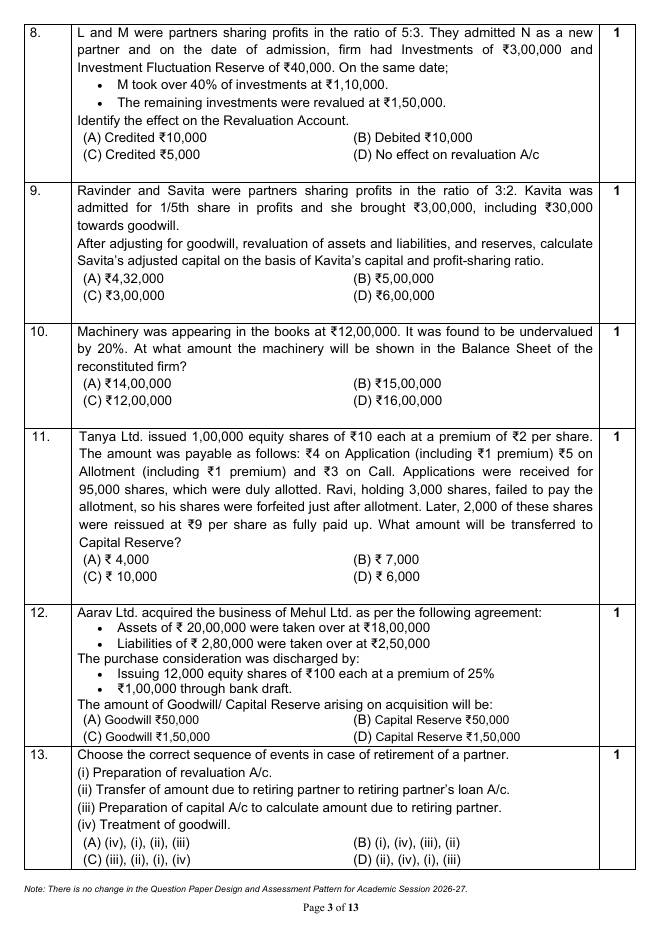
8.         L and M were partners sharing profits in the ratio of 5:3. They admitted N as a new              1
            partner and on the date of admission, firm had Investments of ₹3,00,000 and
            Investment Fluctuation Reserve of ₹40,000. On the same date;
               • M took over 40% of investments at ₹1,10,000.
               • The remaining investments were revalued at ₹1,50,000.
            Identify the effect on the Revaluation Account.
             (A) Credited ₹10,000                           (B) Debited ₹10,000
             (C) Credited ₹5,000                            (D) No effect on revaluation A/c
Official CBSE answer and marking
8. (D) No effect on revaluation A/c 1Original pages for Question 8
 Motivation"Genius is one percent inspiration and ninety nine percent perspiration." : Thomas EdisonNow write it yourselfYou have read, listened and understood. Now close the answer, take a blank page and write and solve this question on your own, in proper CBSE format, with a timer running. Then check against the model answer. That effort will give you confidence for this type and similar types of questions.
- Question 91 mark
9.         Ravinder and Savita were partners sharing profits in the ratio of 3:2. Kavita was                1
            admitted for 1/5th share in profits and she brought ₹3,00,000, including ₹30,000
            towards goodwill.
            After adjusting for goodwill, revaluation of assets and liabilities, and reserves, calculate
            Savita’s adjusted capital on the basis of Kavita’s capital and profit-sharing ratio.
             (A) ₹4,32,000                                   (B) ₹5,00,000
             (C) ₹3,00,000                                   (D) ₹6,00,000
Official CBSE answer and marking
9. (A) ₹4,32,000 1Original pages for Question 9
Motivation"I have not failed. I have just found 10,000 ways that will not work." : Thomas Edison (attributed)Now write it yourselfYou have read, listened and understood. Now close the answer, take a blank page and write and solve this question on your own, in proper CBSE format, with a timer running. Then check against the model answer. That effort will give you confidence for this type and similar types of questions. - Question 101 mark
10.        Machinery was appearing in the books at ₹12,00,000. It was found to be undervalued               1
            by 20%. At what amount the machinery will be shown in the Balance Sheet of the
            reconstituted firm?
             (A) ₹14,00,000                            (B) ₹15,00,000
             (C) ₹12,00,000                            (D) ₹16,00,000
Official CBSE answer and marking
10. (B) ₹15,00,000 1Original pages for Question 10
Motivation"It does not matter how slowly you go as long as you do not stop." : Confucius (attributed)Now write it yourselfYou have read, listened and understood. Now close the answer, take a blank page and write and solve this question on your own, in proper CBSE format, with a timer running. Then check against the model answer. That effort will give you confidence for this type and similar types of questions. - Question 111 mark
11.         Tanya Ltd. issued 1,00,000 equity shares of ₹10 each at a premium of ₹2 per share.              1
             The amount was payable as follows: ₹4 on Application (including ₹1 premium) ₹5 on
             Allotment (including ₹1 premium) and ₹3 on Call. Applications were received for
             95,000 shares, which were duly allotted. Ravi, holding 3,000 shares, failed to pay the
             allotment, so his shares were forfeited just after allotment. Later, 2,000 of these shares
             were reissued at ₹9 per share as fully paid up. What amount will be transferred to
             Capital Reserve?
              (A) ₹ 4,000                                     (B) ₹ 7,000
              (C) ₹ 10,000                                    (D) ₹ 6,000
Official CBSE answer and marking
11. (A) ₹4,000 1Original pages for Question 11
Motivation"Learning never exhausts the mind." : Leonardo da VinciNow write it yourselfYou have read, listened and understood. Now close the answer, take a blank page and write and solve this question on your own, in proper CBSE format, with a timer running. Then check against the model answer. That effort will give you confidence for this type and similar types of questions. - Question 121 mark
12.        Aarav Ltd. acquired the business of Mehul Ltd. as per the following agreement:                   1
                  • Assets of ₹ 20,00,000 were taken over at ₹18,00,000
                  • Liabilities of ₹ 2,80,000 were taken over at ₹2,50,000
            The purchase consideration was discharged by:
                  • Issuing 12,000 equity shares of ₹100 each at a premium of 25%
                  • ₹1,00,000 through bank draft.
            The amount of Goodwill/ Capital Reserve arising on acquisition will be:
             (A) Goodwill ₹50,000                             (B) Capital Reserve ₹50,000
             (C) Goodwill ₹1,50,000                           (D) Capital Reserve ₹1,50,000
Official CBSE answer and marking
12. (A) Goodwill ₹50,000 1Original pages for Question 12
Motivation"Do not watch the clock; do what it does. Keep going." : Sam LevensonNow write it yourselfYou have read, listened and understood. Now close the answer, take a blank page and write and solve this question on your own, in proper CBSE format, with a timer running. Then check against the model answer. That effort will give you confidence for this type and similar types of questions. - Question 131 mark
13.        Choose the correct sequence of events in case of retirement of a partner.                        1
            (i) Preparation of revaluation A/c.
            (ii) Transfer of amount due to retiring partner to retiring partner’s loan A/c.
            (iii) Preparation of capital A/c to calculate amount due to retiring partner.
            (iv) Treatment of goodwill.
             (A) (iv), (i), (ii), (iii)                       (B) (i), (iv), (iii), (ii)
             (C) (iii), (ii), (i), (iv)                       (D) (ii), (iv), (i), (iii)
Official CBSE answer and marking
13. (B) (i), (iv), (iii), (ii) 1Original pages for Question 13
Motivation"You do not have to be great to start, but you have to start to be great." : Zig ZiglarNow write it yourselfYou have read, listened and understood. Now close the answer, take a blank page and write and solve this question on your own, in proper CBSE format, with a timer running. Then check against the model answer. That effort will give you confidence for this type and similar types of questions. - Question 141 mark
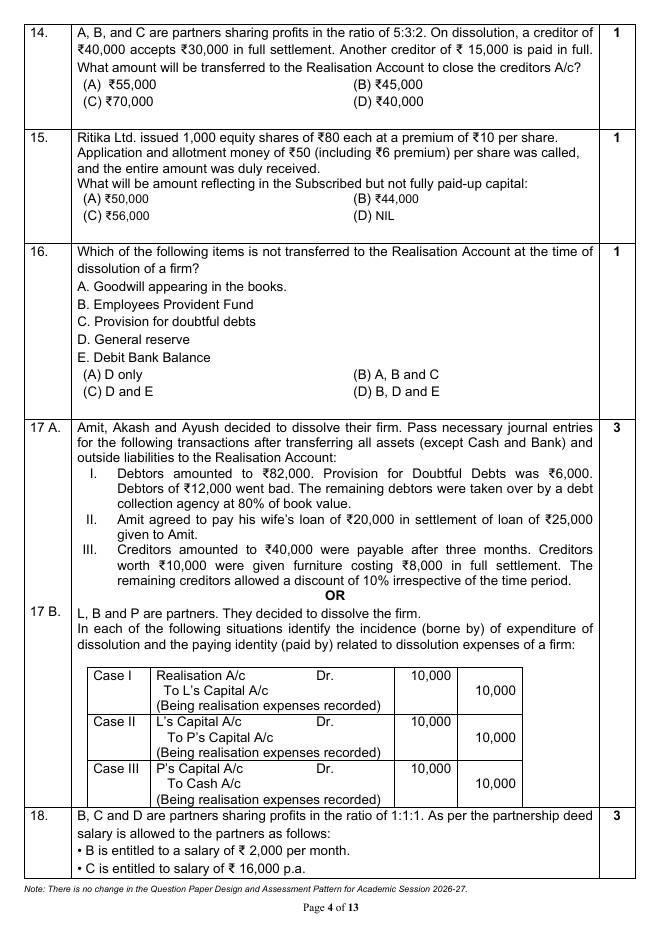
14.        A, B, and C are partners sharing profits in the ratio of 5:3:2. On dissolution, a creditor of    1
            ₹40,000 accepts ₹30,000 in full settlement. Another creditor of ₹ 15,000 is paid in full.
            What amount will be transferred to the Realisation Account to close the creditors A/c?
             (A) ₹55,000                                     (B) ₹45,000
             (C) ₹70,000                                     (D) ₹40,000
Official CBSE answer and marking
14. (A) ₹55,000 1Original pages for Question 14
 Motivation"An investment in knowledge pays the best interest." : Benjamin Franklin (attributed)Now write it yourselfYou have read, listened and understood. Now close the answer, take a blank page and write and solve this question on your own, in proper CBSE format, with a timer running. Then check against the model answer. That effort will give you confidence for this type and similar types of questions.
- Question 151 mark
15.        Ritika Ltd. issued 1,000 equity shares of ₹80 each at a premium of ₹10 per share.                1
            Application and allotment money of ₹50 (including ₹6 premium) per share was called,
            and the entire amount was duly received.
            What will be amount reflecting in the Subscribed but not fully paid-up capital:
             (A) ₹50,000                                   (B) ₹44,000
             (C) ₹56,000                                   (D) NIL
Official CBSE answer and marking
15. (B) ₹44,000 1Original pages for Question 15
Motivation"Pure mathematics is, in its way, the poetry of logical ideas." : Albert EinsteinNow write it yourselfYou have read, listened and understood. Now close the answer, take a blank page and write and solve this question on your own, in proper CBSE format, with a timer running. Then check against the model answer. That effort will give you confidence for this type and similar types of questions. - Question 161 mark
16.        Which of the following items is not transferred to the Realisation Account at the time of        1
            dissolution of a firm?
            A. Goodwill appearing in the books.
            B. Employees Provident Fund
            C. Provision for doubtful debts
            D. General reserve
            E. Debit Bank Balance
             (A) D only                                     (B) A, B and C
             (C) D and E                                    (D) B, D and E
Official CBSE answer and marking
16. (C) D and E 1Original pages for Question 16
Motivation"Success is the sum of small efforts, repeated day in and day out." : Robert CollierNow write it yourselfYou have read, listened and understood. Now close the answer, take a blank page and write and solve this question on your own, in proper CBSE format, with a timer running. Then check against the model answer. That effort will give you confidence for this type and similar types of questions. - Question 173 marks
17 A.      Amit, Akash and Ayush decided to dissolve their firm. Pass necessary journal entries             3
            for the following transactions after transferring all assets (except Cash and Bank) and
            outside liabilities to the Realisation Account:
               I. Debtors amounted to ₹82,000. Provision for Doubtful Debts was ₹6,000.
                   Debtors of ₹12,000 went bad. The remaining debtors were taken over by a debt
                   collection agency at 80% of book value.
              II. Amit agreed to pay his wife’s loan of ₹20,000 in settlement of loan of ₹25,000
                   given to Amit.
             III. Creditors amounted to ₹40,000 were payable after three months. Creditors
                   worth ₹10,000 were given furniture costing ₹8,000 in full settlement. The
                   remaining creditors allowed a discount of 10% irrespective of the time period.
                                                        OR
 17 B.      L, B and P are partners. They decided to dissolve the firm.
            In each of the following situations identify the incidence (borne by) of expenditure of
            dissolution and the paying identity (paid by) related to dissolution expenses of a firm:
                Case I     Realisation A/c              Dr.            10,000
                             To L’s Capital A/c                                    10,000
                           (Being realisation expenses recorded)
               Case II     L’s Capital A/c              Dr.            10,000
                              To P’s Capital A/c                                   10,000
                           (Being realisation expenses recorded)
               Case III P’s Capital A/c                 Dr.            10,000
                              To Cash A/c                                          10,000
                           (Being realisation expenses recorded)
Official CBSE answer and marking
17 A. JOURNAL 3 SN. Particulars LF Debit (₹) Credit (₹)Particulars L.F. Debit (₹) Credit (₹) I. Bank A/c Dr. 56,000 To Realisation A/c 56,000 (Being debtors realised)Particulars L.F. Debit (₹) Credit (₹) II. Realisation A/c Dr. 25,000 To Amit’s loan A/c 25,000 (Being loan settled)Particulars L.F. Debit (₹) Credit (₹) III. Realisation A/c Dr. 27,000 To Cash A/c 27,000 (Being creditors paid off) OR 17 B. Case I Expenses borne by firm, paid by partner L. Case II Expenses borne by partner L, paid by partner P. Case III Expenses borne by partner P, paid by firm.Independent verification noteQ17A(ii): The firm has a ₹25,000 loan receivable from Amit and a ₹20,000 liability to his wife. Amit's undertaking to pay his wife's loan is accepted in settlement of his loan. On that full-settlement reading, the official entry Realisation A/c Dr ₹25,000; To Amit's Loan A/c ₹25,000 is defensible: the ₹5,000 difference is a realisation loss. Realisation Dr ₹20,000 and Amit's Capital Dr ₹5,000; To Amit's Loan ₹25,000 would instead require the remaining ₹5,000 to be borne separately by Amit; the printed question does not expressly require this.Original pages for Question 17
Motivation"The expert in anything was once a beginner." : Helen Hayes (attributed)Now write it yourselfYou have read, listened and understood. Now close the answer, take a blank page and write and solve this question on your own, in proper CBSE format, with a timer running. Then check against the model answer. That effort will give you confidence for this type and similar types of questions. - Question 183 marks
18.        B, C and D are partners sharing profits in the ratio of 1:1:1. As per the partnership deed       3
            salary is allowed to the partners as follows:
            • B is entitled to a salary of ₹ 2,000 per month.
            • C is entitled to salary of ₹ 16,000 p.a.
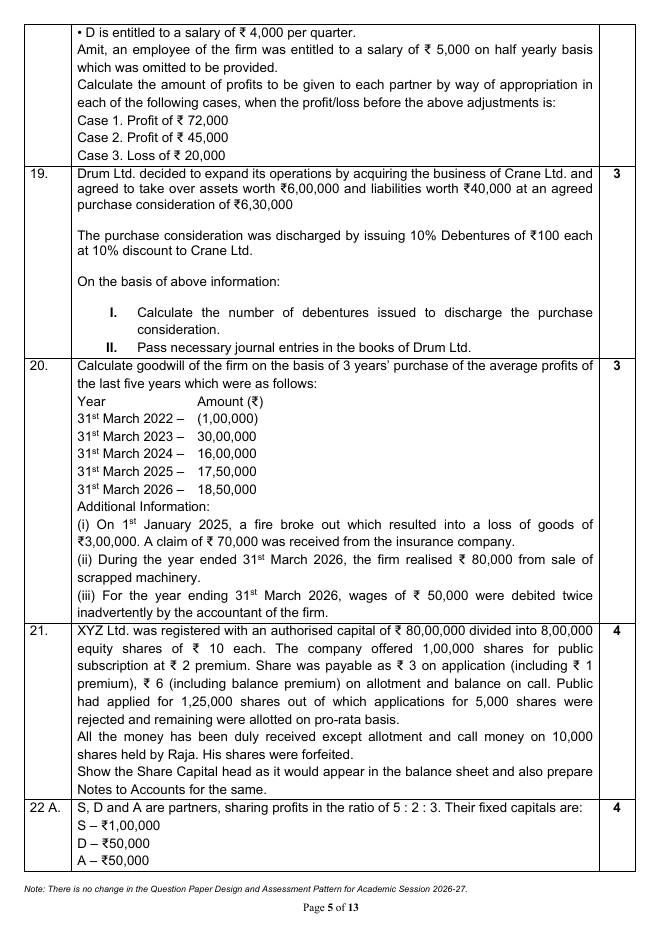
            • D is entitled to a salary of ₹ 4,000 per quarter.
            Amit, an employee of the firm was entitled to a salary of ₹ 5,000 on half yearly basis
            which was omitted to be provided.
            Calculate the amount of profits to be given to each partner by way of appropriation in
            each of the following cases, when the profit/loss before the above adjustments is:
            Case 1. Profit of ₹ 72,000
            Case 2. Profit of ₹ 45,000
            Case 3. Loss of ₹ 20,000
Official CBSE answer and marking
18. Annual Salary of Each Partner 3 B (₹2,000 per month) = 2,000×12= ₹24,000 C = ₹16,000 per annum D (₹4,000 per quarter) = 4,000×4= ₹16,000 Total Salary = 24,000+16,000+16,000= ₹56,000 Profit-sharing ratio = 1:1:1 Case 1: Net Profit = ₹72,000 - ₹10,000 (Salary to employee) Profit > Total Salary (₹56,000) Remaining Profit: 62,000−56,000 = 6,000 This ₹6,000 is divided equally: 6,000÷3 = ₹ 2,000 each Case 2: Net Profit 35,000 (45,000-10,000) < Total Salary (₹56,000) When profit is insufficient, available profit is divided in the ratio of actual appropriations which in the given case is 24,000:16,000:16,000, i.e. 3:2:2 So ₹35,000 will be divided in 3:2:2 B’s share= 35,000*3/7= ₹ 15,000 C’s share= 35,000*2/7= ₹ 10,000 D’s share= 35,000*2/7= ₹ 10,000 Case 3: Net Loss = ₹20,000+10,000= ₹ 30,000 In case of loss, no salary is allowed. Loss is shared equally. 30,000÷3 = ₹ 10,000 eachOriginal pages for Question 18
 Motivation"Chase your dreams. Dreams do come true." : Sachin Tendulkar, CricketNow write it yourselfYou have read, listened and understood. Now close the answer, take a blank page and write and solve this question on your own, in proper CBSE format, with a timer running. Then check against the model answer. That effort will give you confidence for this type and similar types of questions.
- Question 193 marks
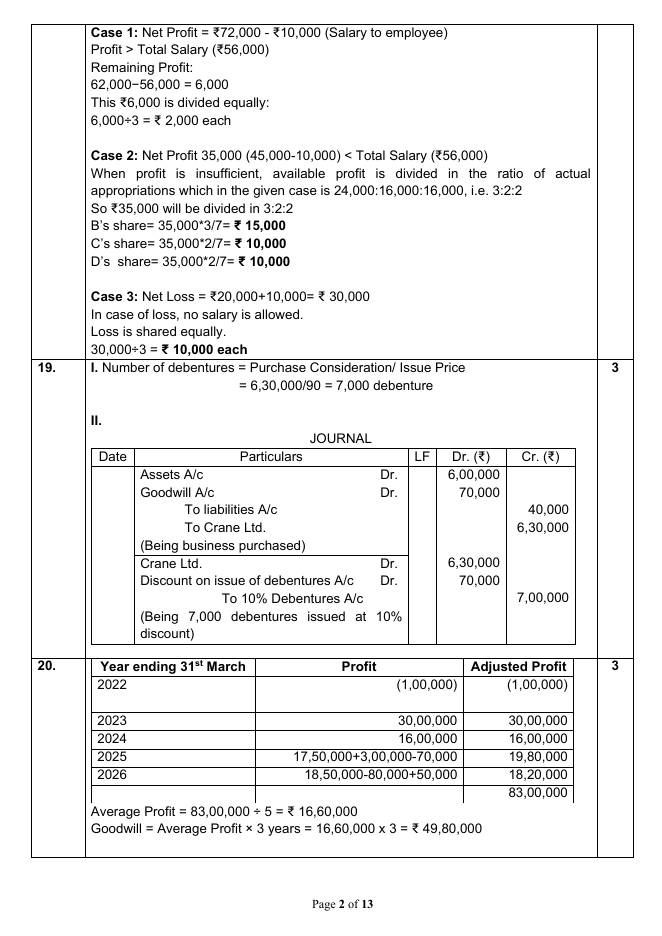
19.        Drum Ltd. decided to expand its operations by acquiring the business of Crane Ltd. and           3
            agreed to take over assets worth ₹6,00,000 and liabilities worth ₹40,000 at an agreed
            purchase consideration of ₹6,30,000
            The purchase consideration was discharged by issuing 10% Debentures of ₹100 each
            at 10% discount to Crane Ltd.
            On the basis of above information:
                    I.  Calculate the number of debentures issued to discharge the purchase
                        consideration.
                   II. Pass necessary journal entries in the books of Drum Ltd.
Official CBSE answer and marking
19. I. Number of debentures = Purchase Consideration/ Issue Price 3 = 6,30,000/90 = 7,000 debenture II. JOURNAL Date Particulars LF Dr. (₹) Cr. (₹)Particulars L.F. Debit (₹) Credit (₹) Assets A/c Dr. 6,00,000 Goodwill A/c Dr. 70,000 To liabilities A/c 40,000 To Crane Ltd. 6,30,000 (Being business purchased)Particulars L.F. Debit (₹) Credit (₹) Crane Ltd. Dr. 6,30,000 Discount on issue of debentures A/c Dr. 70,000 To 10% Debentures A/c 7,00,000 (Being 7,000 debentures issued at 10% discount)Original pages for Question 19
Motivation"Self belief and hard work will always earn you success." : Virat Kohli, Cricket (attributed)Now write it yourselfYou have read, listened and understood. Now close the answer, take a blank page and write and solve this question on your own, in proper CBSE format, with a timer running. Then check against the model answer. That effort will give you confidence for this type and similar types of questions. - Question 203 marks
20.        Calculate goodwill of the firm on the basis of 3 years’ purchase of the average profits of       3
            the last five years which were as follows:
            Year                  Amount (₹)
                st
            31 March 2022 - (1,00,000)
            31st March 2023 - 30,00,000
            31st March 2024 - 16,00,000
            31st March 2025 - 17,50,000
            31st March 2026 - 18,50,000
            Additional Information:
            (i) On 1st January 2025, a fire broke out which resulted into a loss of goods of
            ₹3,00,000. A claim of ₹ 70,000 was received from the insurance company.
            (ii) During the year ended 31st March 2026, the firm realised ₹ 80,000 from sale of
            scrapped machinery.
            (iii) For the year ending 31st March 2026, wages of ₹ 50,000 were debited twice
            inadvertently by the accountant of the firm.
Official CBSE answer and marking
20. Year ending 31st March Profit Adjusted Profit 3 2022 (1,00,000) (1,00,000) 2023 30,00,000 30,00,000 2024 16,00,000 16,00,000 2025 17,50,000+3,00,000-70,000 19,80,000 2026 18,50,000-80,000+50,000 18,20,000 83,00,000 Average Profit = 83,00,000 ÷ 5 = ₹ 16,60,000 Goodwill = Average Profit × 3 years = 16,60,000 x 3 = ₹ 49,80,000Independent verification noteThe official goodwill ₹49,80,000 assumes ₹80,000 scrap-machinery proceeds were included in profit as a non-recurring gain. Proceeds alone do not establish the gain without the asset's carrying amount; retain this assumption.Original pages for Question 20
Motivation"Focus on the process, and the results will follow." : M. S. Dhoni, Cricket (attributed)Now write it yourselfYou have read, listened and understood. Now close the answer, take a blank page and write and solve this question on your own, in proper CBSE format, with a timer running. Then check against the model answer. That effort will give you confidence for this type and similar types of questions. - Question 214 marks
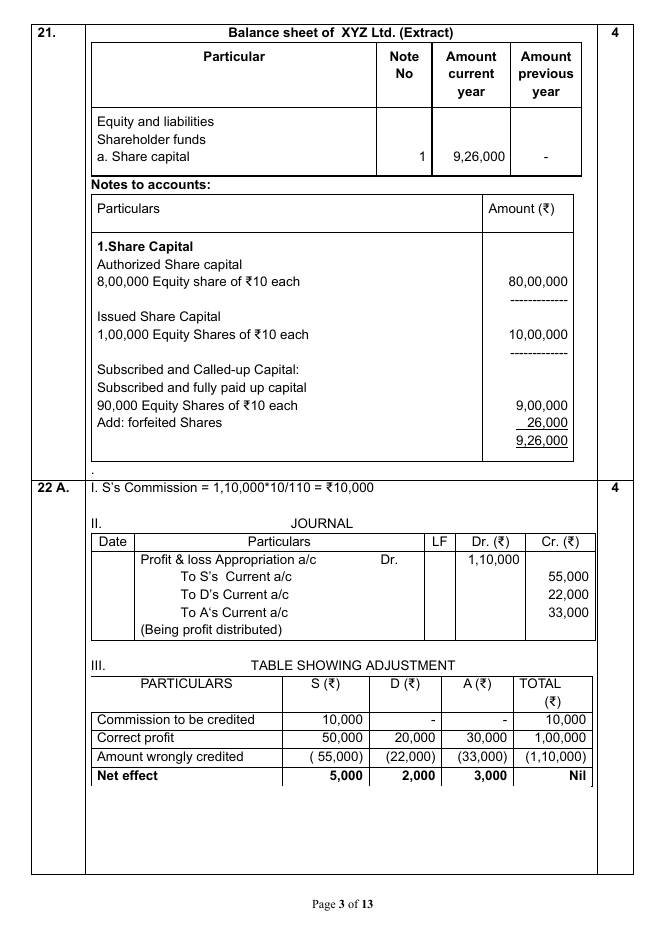
21.        XYZ Ltd. was registered with an authorised capital of ₹ 80,00,000 divided into 8,00,000          4
            equity shares of ₹ 10 each. The company offered 1,00,000 shares for public
            subscription at ₹ 2 premium. Share was payable as ₹ 3 on application (including ₹ 1
            premium), ₹ 6 (including balance premium) on allotment and balance on call. Public
            had applied for 1,25,000 shares out of which applications for 5,000 shares were
            rejected and remaining were allotted on pro-rata basis.
            All the money has been duly received except allotment and call money on 10,000
            shares held by Raja. His shares were forfeited.
            Show the Share Capital head as it would appear in the balance sheet and also prepare
            Notes to Accounts for the same.
Official CBSE answer and marking
21. Balance sheet of XYZ Ltd. (Extract) 4 Particular Note Amount Amount No current previous year year Equity and liabilities Shareholder funds a. Share capital 1 9,26,000 - Notes to accounts: Particulars Amount (₹) 1.Share Capital Authorized Share capital 8,00,000 Equity share of ₹10 each 80,00,000 ------------- Issued Share Capital 1,00,000 Equity Shares of ₹10 each 10,00,000 ------------- Subscribed and Called-up Capital: Subscribed and fully paid up capital 90,000 Equity Shares of ₹10 each 9,00,000 Add: forfeited Shares 26,000 9,26,000 .Original pages for Question 21
 Motivation"Hard work beats talent when talent does not work hard." : Tim Notke, Basketball coachNow write it yourselfYou have read, listened and understood. Now close the answer, take a blank page and write and solve this question on your own, in proper CBSE format, with a timer running. Then check against the model answer. That effort will give you confidence for this type and similar types of questions.
- Question 224 marks
22 A.      S, D and A are partners, sharing profits in the ratio of 5 : 2 : 3. Their fixed capitals are:    4
            S - ₹1,00,000
            D - ₹50,000
            A - ₹50,000
            As per the partnership deed, S is entitled to a commission of 10% of net profit after
            charging such commission.
            However, while preparing the accounts for the year ended 31st March 2026, this
            commission was not provided. The net profit of the firm was ₹1,10,000.
            On the basis of above information:
               I. Calculate the correct amount of commission payable to S.
              II. Pass the necessary journal entry that the accountant would have passed for
                    distribution of profits without providing commission to S.
             III. Pass the necessary adjusting journal entry at the beginning of the next year to
                    rectify the above-mentioned error.
                                                              OR
 22 B.        Alpha, Beta and Delta were partners. On 31st August 2023, Delta died and after all
              the adjustments an amount of Rs.3,22,000 was payable to his executors. It was
              agreed to pay Rs.22,000 immediately and balance in 3 equal instalments together
              with interest @10%p.a. on 31st March 2024, 31st March 2025 and 31st March 2026,
              Prepare Delta’s Executors account till it is finally paid off.
Official CBSE answer and marking
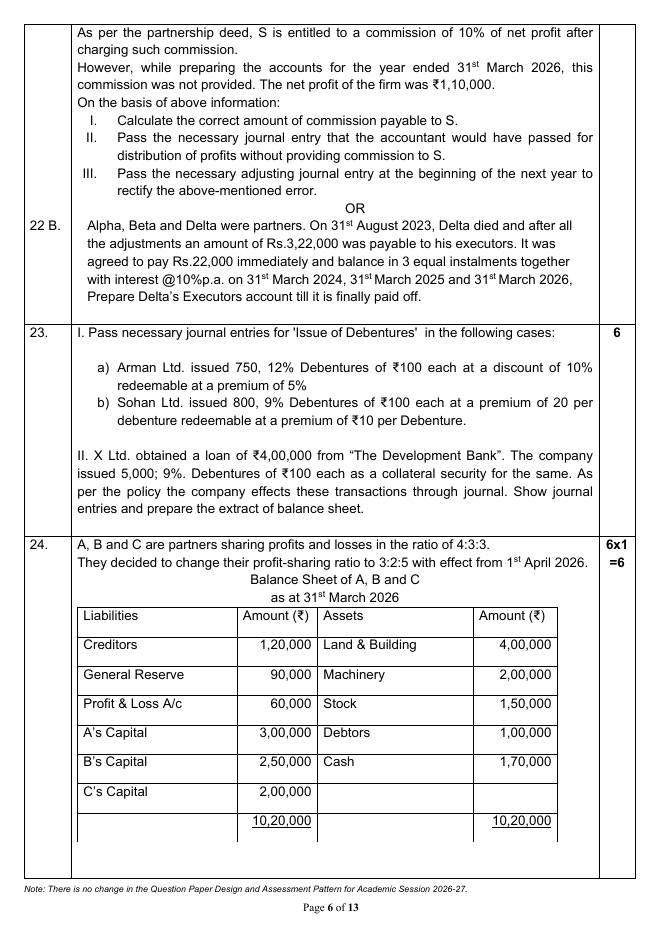
22 A. I. S’s Commission = 1,10,000*10/110 = ₹10,000 4 II. JOURNAL Date Particulars LF Dr. (₹) Cr. (₹)Particulars L.F. Debit (₹) Credit (₹) Profit & loss Appropriation a/c Dr. 1,10,000 To S’s Current a/c 55,000 To D’s Current a/c 22,000 To A‘s Current a/c 33,000 (Being profit distributed) III. TABLE SHOWING ADJUSTMENT PARTICULARS S (₹) D (₹) A (₹) TOTAL (₹) Commission to be credited 10,000 - - 10,000 Correct profit 50,000 20,000 30,000 1,00,000 Amount wrongly credited ( 55,000) (22,000) (33,000) (1,10,000) Net effect 5,000 2,000 3,000 Nil JOURNAL Date Particulars LF Dr. (₹) Cr. (₹)Particulars L.F. Debit (₹) Credit (₹) D’s Current a/c Dr. 2,000 A’s Current a/c Dr. 3,000 To S’s Current a/c 5,000 (Being adjustment of omitted commission) 22 B. Dr. Delta’s Executor’s A/c Cr. Date Particulars (₹) Date Particulars (₹) 31-08-23 To Bank A/c 22,000 31-08-23 By Delta’s Capital A/c 3,22,000 31-03-24 To Bank A/c 1,17,500 31-03-24 By Interest A/c 17,500 31-03-24 To Balance c/d 2,00,000 3,39,500 3,39,500 31-03-25 To Bank A/c 1,20,000 1-04-24 By Balance b/d 2,00,000 31-03-25 To Balance c/d 1,00,000 31-3-25 By Interest A/c 20,000 2,20,000 2,20,000 31-03-26 To Bank A/c 1,10,000 1-04-25 By Balance b/d 1,00,000 31-3-26 By Interest A/c 10,000 1,10,000 1,10,000Original pages for Question 22
 Motivation"Champions keep playing until they get it right." : Billie Jean King, TennisNow write it yourselfYou have read, listened and understood. Now close the answer, take a blank page and write and solve this question on your own, in proper CBSE format, with a timer running. Then check against the model answer. That effort will give you confidence for this type and similar types of questions.
- Question 236 marks
23.        I. Pass necessary journal entries for 'Issue of Debentures' in the following cases:                           6
                 a) Arman Ltd. issued 750, 12% Debentures of ₹100 each at a discount of 10%
                    redeemable at a premium of 5%
                 b) Sohan Ltd. issued 800, 9% Debentures of ₹100 each at a premium of 20 per
                    debenture redeemable at a premium of ₹10 per Debenture.
            II. X Ltd. obtained a loan of ₹4,00,000 from “The Development Bank”. The company
            issued 5,000; 9%. Debentures of ₹100 each as a collateral security for the same. As
            per the policy the company effects these transactions through journal. Show journal
            entries and prepare the extract of balance sheet.
Official CBSE answer and marking
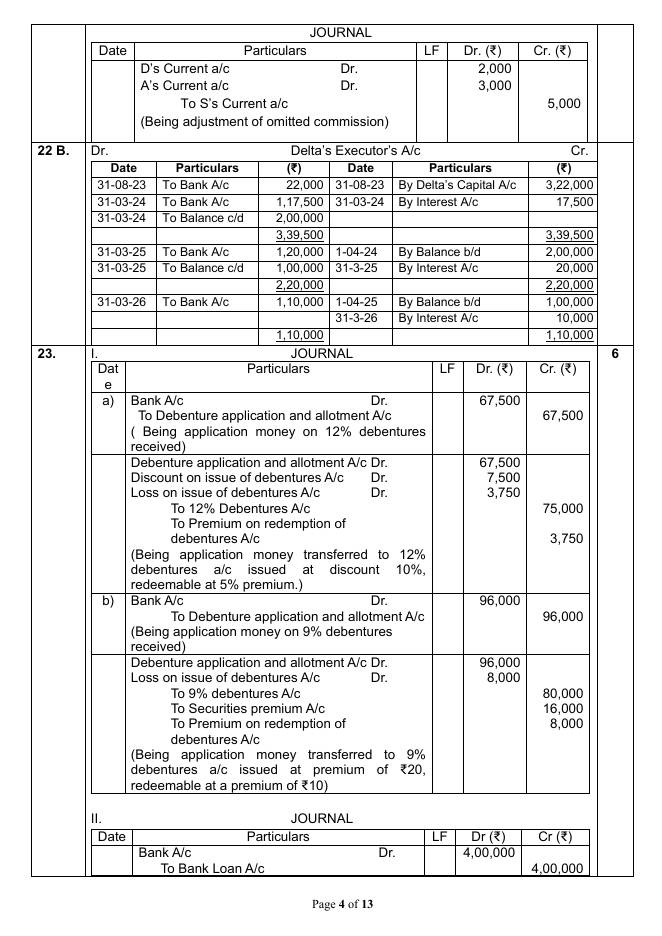
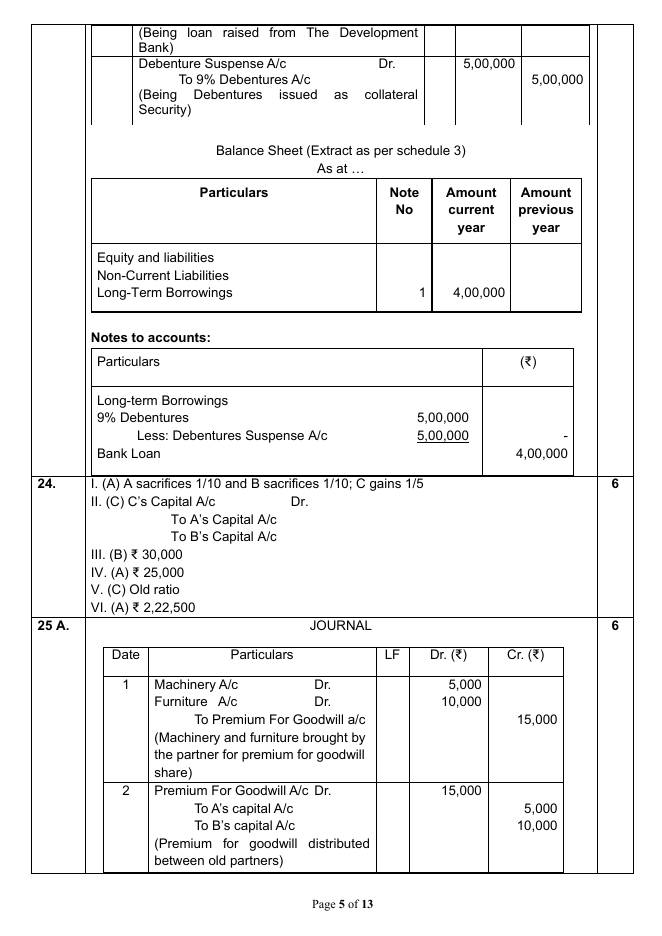
23. I. JOURNAL 6 Dat Particulars LF Dr. (₹) Cr. (₹) eParticulars L.F. Debit (₹) Credit (₹) a) Bank A/c Dr. 67,500 To Debenture application and allotment A/c 67,500 ( Being application money on 12% debentures received)Particulars L.F. Debit (₹) Credit (₹) Debenture application and allotment A/c Dr. 67,500 Discount on issue of debentures A/c Dr. 7,500 Loss on issue of debentures A/c Dr. 3,750 To 12% Debentures A/c 75,000 To Premium on redemption of debentures A/c 3,750 (Being application money transferred to 12% debentures a/c issued at discount 10%, redeemable at 5% premium.)Particulars L.F. Debit (₹) Credit (₹) b) Bank A/c Dr. 96,000 To Debenture application and allotment A/c 96,000 (Being application money on 9% debentures received)Particulars L.F. Debit (₹) Credit (₹) Debenture application and allotment A/c Dr. 96,000 Loss on issue of debentures A/c Dr. 8,000 To 9% debentures A/c 80,000 To Securities premium A/c 16,000 To Premium on redemption of 8,000 debentures A/c (Being application money transferred to 9% debentures a/c issued at premium of ₹20, redeemable at a premium of ₹10) II. JOURNAL Date Particulars LF Dr (₹) Cr (₹)Particulars L.F. Debit (₹) Credit (₹) Bank A/c Dr. 4,00,000 To Bank Loan A/c 4,00,000 (Being loan raised from The Development Bank)Particulars L.F. Debit (₹) Credit (₹) Debenture Suspense A/c Dr. 5,00,000 To 9% Debentures A/c 5,00,000 (Being Debentures issued as collateral Security) Balance Sheet (Extract as per schedule 3) As at … Particulars Note Amount Amount No current previous year year Equity and liabilities Non-Current Liabilities Long-Term Borrowings 1 4,00,000 Notes to accounts: Particulars (₹) Long-term Borrowings 9% Debentures 5,00,000 Less: Debentures Suspense A/c 5,00,000 - Bank Loan 4,00,000Original pages for Question 23
 Motivation"I have failed over and over and over again in my life. And that is why I succeed." : Michael Jordan, BasketballNow write it yourselfYou have read, listened and understood. Now close the answer, take a blank page and write and solve this question on your own, in proper CBSE format, with a timer running. Then check against the model answer. That effort will give you confidence for this type and similar types of questions.
- Question 246 marks
24.        A, B and C are partners sharing profits and losses in the ratio of 4:3:3.                                    6x1
            They decided to change their profit-sharing ratio to 3:2:5 with effect from 1st April 2026.                  =6
                                         Balance Sheet of A, B and C
                                            as at 31st March 2026
             Liabilities               Amount (₹) Assets                            Amount (₹)
              Creditors                                 1,20,000 Land & Building                              4,00,000
              General Reserve                             90,000 Machinery                                    2,00,000
              Profit & Loss A/c                           60,000 Stock                                        1,50,000
              A’s Capital                               3,00,000 Debtors                                      1,00,000
              B’s Capital                               2,50,000 Cash                                         1,70,000
              C’s Capital                               2,00,000
                                                      10,20,000                                              10,20,000
            Additional Information:
            1. Goodwill of the firm is valued at ₹1,50,000.
            2. Land & Building is revalued at ₹4,50,000.
            3. A provision for doubtful debts @5% is to be created on debtors.
            4. An unrecorded liability of ₹20,000 is discovered.
            Based on the above information answer the following MCQs:
            I. The net sacrifice made by partners (in terms of share of profit) is:
            A) A sacrifices 1/10 and B sacrifices 1/10; C gains 1/5
            B) A gains 1/10; B gains 1/10; C sacrifices 1/10
            C) A sacrifices 1/10; B gains 1/10; C gains 1/5
            D) A gains 1/10, B gains 1/10; C sacrifices 1/5
            II. Which of the following journal entries is correct for treatment of goodwill?
              (A)   A’s Capital A/c              Dr.           (B)     A’s Capital A/c     Dr.
                            To C’s Capital A/c                         B’s Capital A/c     Dr.
                                                                             To C’s Capital A/c
              (C)      C’s Capital A/c                       Dr.              (D)       C’s Capital A/c    Dr.
                             To A’s Capital A/c                                         A’s Capital A/c    Dr.
                             To B’s Capital A/c                                               To Goodwill A/c
            III. The amount of goodwill to be compensated by gaining partner(s) is:
              (A) ₹45,000                                 (B) ₹30,000
              (C) ₹75,000                                 (D) ₹1,50,000
            IV. The net gain on revaluation will be:
             (A) ₹25,000                                                      (B) ₹20,000
             (C) ₹5,000                                                       (D) ₹30,000
            V. General Reserve and Profit & Loss Account will be distributed in:
             (A) New ratio                              (B) Gaining ratio
             (C) Old ratio                              (D) Sacrificing ratio
            VI. After all adjustments, the balance of C’s capital will be?
             (A) ₹2,22,500                                  (B) ₹2,35,000
             (C) ₹3,00,000                                  (D) ₹3,50,000
Official CBSE answer and marking
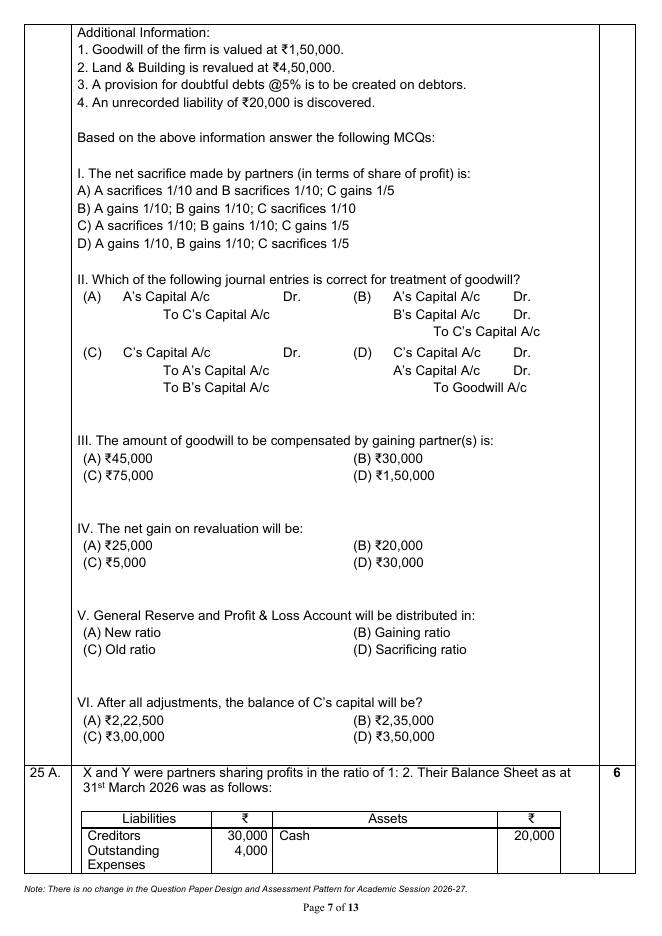
24. I. (A) A sacrifices 1/10 and B sacrifices 1/10; C gains 1/5 6 II. (C) C’s Capital A/c Dr. To A’s Capital A/c To B’s Capital A/c III. (B) ₹ 30,000 IV. (A) ₹ 25,000 V. (C) Old ratio VI. (A) ₹ 2,22,500Original pages for Question 24
 Motivation"Everything negative, pressure, challenges, is all an opportunity for me to rise." : Kobe Bryant, BasketballNow write it yourselfYou have read, listened and understood. Now close the answer, take a blank page and write and solve this question on your own, in proper CBSE format, with a timer running. Then check against the model answer. That effort will give you confidence for this type and similar types of questions.
- Question 256 marks
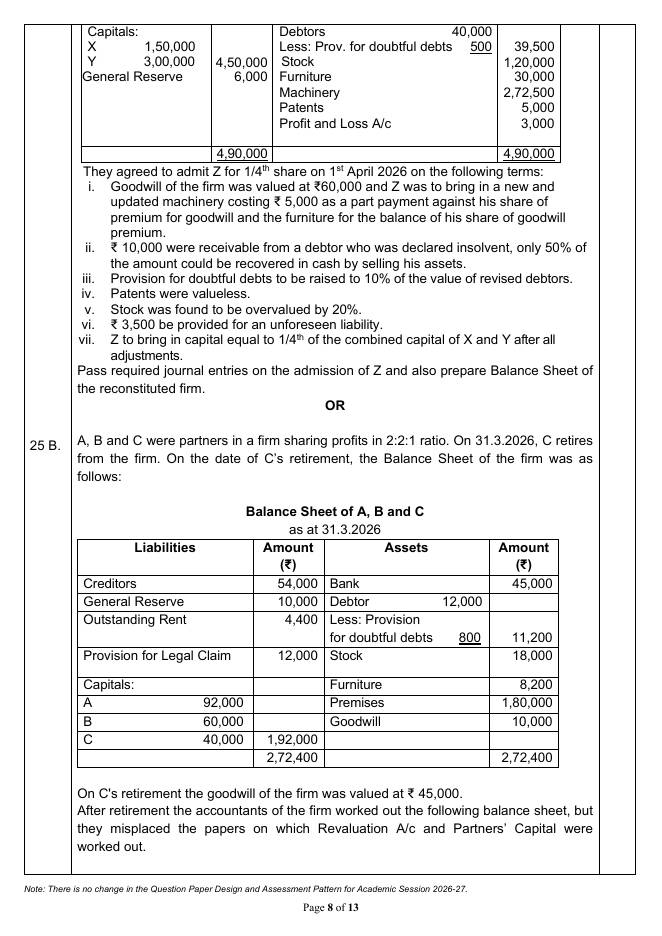
25 A.        X and Y were partners sharing profits in the ratio of 1: 2. Their Balance Sheet as at                   6
              31st March 2026 was as follows:
                     Liabilities                  ₹                               Assets                       ₹
               Creditors                        30,000 Cash                                                  20,000
               Outstanding                       4,000
               Expenses
              Capitals:                               Debtors                       40,000
              X         1,50,000                      Less: Prov. for doubtful debts 500     39,500
              Y         3,00,000             4,50,000 Stock                                1,20,000
             General Reserve                    6,000 Furniture                              30,000
                                                      Machinery                            2,72,500
                                                      Patents                                 5,000
                                                      Profit and Loss A/c                     3,000
                                     4,90,000                                          4,90,000
                                             th            st
             They agreed to admit Z for 1/4 share on 1 April 2026 on the following terms:
               i. Goodwill of the firm was valued at ₹60,000 and Z was to bring in a new and
                  updated machinery costing ₹ 5,000 as a part payment against his share of
                  premium for goodwill and the furniture for the balance of his share of goodwill
                  premium.
              ii. ₹ 10,000 were receivable from a debtor who was declared insolvent, only 50% of
                  the amount could be recovered in cash by selling his assets.
             iii. Provision for doubtful debts to be raised to 10% of the value of revised debtors.
             iv. Patents were valueless.
              v. Stock was found to be overvalued by 20%.
             vi. ₹ 3,500 be provided for an unforeseen liability.
            vii. Z to bring in capital equal to 1/4th of the combined capital of X and Y after all
                  adjustments.
            Pass required journal entries on the admission of Z and also prepare Balance Sheet of
            the reconstituted firm.
                                                          OR
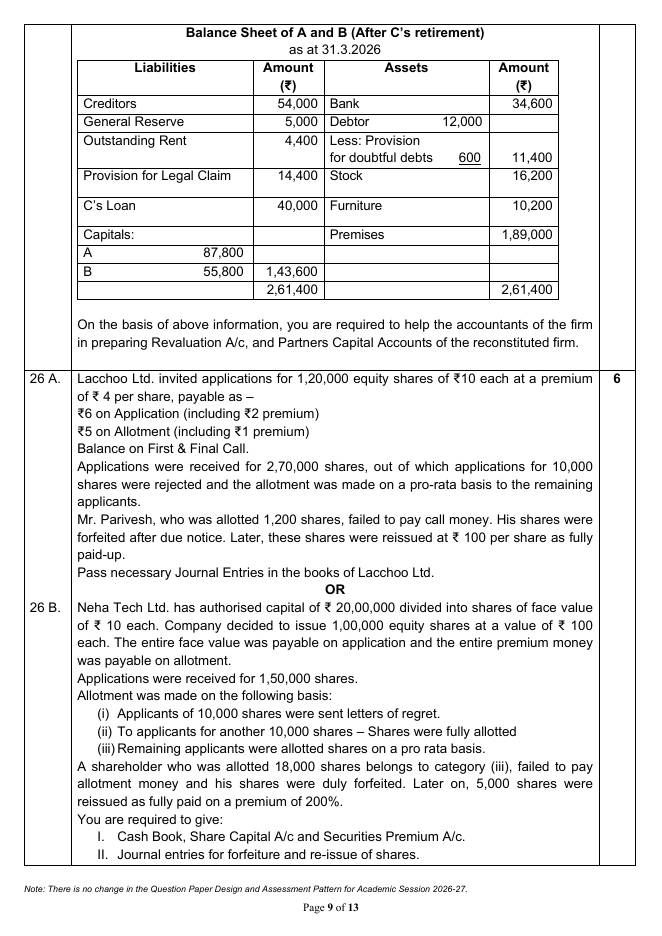
 25 B.      A, B and C were partners in a firm sharing profits in 2:2:1 ratio. On 31.3.2026, C retires
            from the firm. On the date of C’s retirement, the Balance Sheet of the firm was as
            follows:
                                                     Balance Sheet of A, B and C
                                                            as at 31.3.2026
                          Liabilities                  Amount                Assets                          Amount
                                                          (₹)                                                  (₹)
              Creditors                                  54,000 Bank                                          45,000
              General Reserve                            10,000 Debtor                12,000
              Outstanding Rent                             4,400 Less: Provision
                                                                   for doubtful debts    800                  11,200
              Provision for Legal Claim                  12,000 Stock                                         18,000
              Capitals:                                                  Furniture                              8,200
              A                           92,000                         Premises                            1,80,000
              B                           60,000                         Goodwill                              10,000
              C                           40,000          1,92,000
                                                          2,72,400                                           2,72,400
            On C's retirement the goodwill of the firm was valued at ₹ 45,000.
            After retirement the accountants of the firm worked out the following balance sheet, but
            they misplaced the papers on which Revaluation A/c and Partners’ Capital were
            worked out.
                                 Balance Sheet of A and B (After C’s retirement)
                                                 as at 31.3.2026
                       Liabilities          Amount                Assets                                     Amount
                                               (₹)                                                             (₹)
              Creditors                       54,000 Bank                                                     34,600
              General Reserve                   5,000 Debtor               12,000
              Outstanding Rent                  4,400 Less: Provision
                                                        for doubtful debts    600                             11,400
              Provision for Legal Claim       14,400 Stock                                                    16,200
              C’s Loan                                      40,000 Furniture                                  10,200
              Capitals:                                                  Premises                            1,89,000
              A                           87,800
              B                           55,800         1,43,600
                                                         2,61,400                                            2,61,400
            On the basis of above information, you are required to help the accountants of the firm
            in preparing Revaluation A/c, and Partners Capital Accounts of the reconstituted firm.
Official CBSE answer and marking
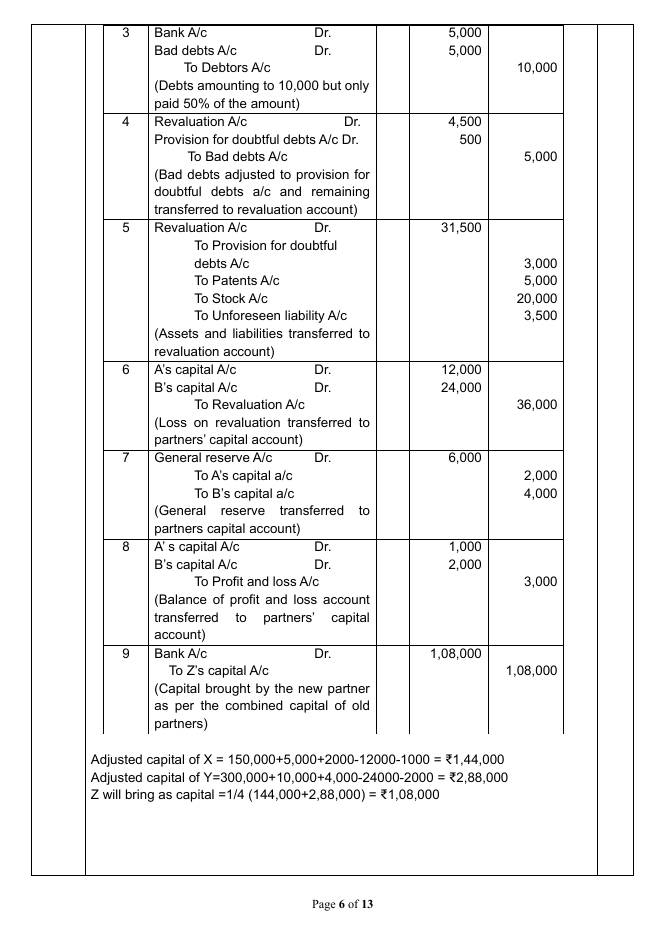
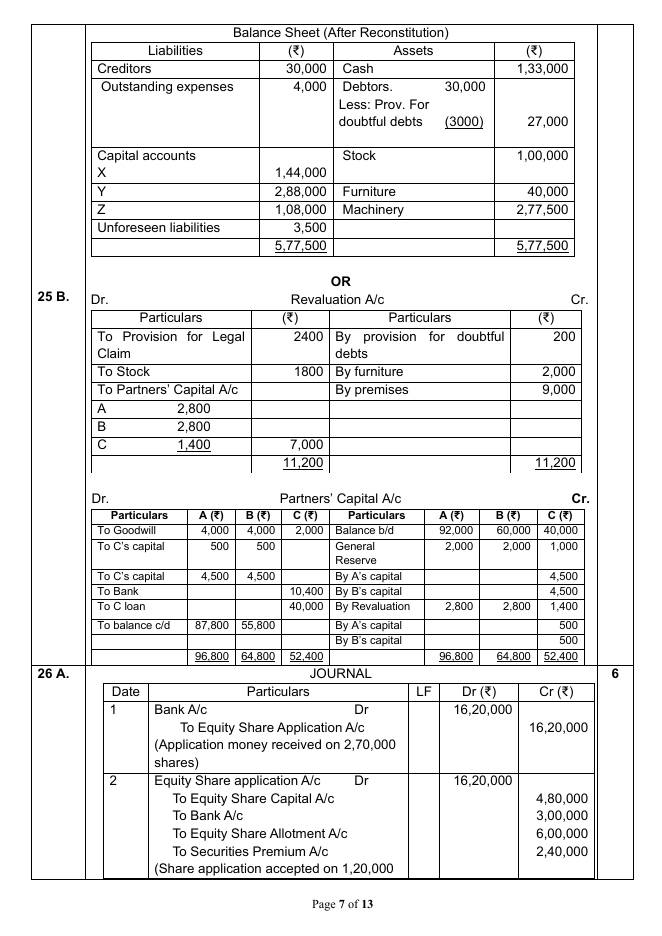
25 A. JOURNAL 6 Date Particulars LF Dr. (₹) Cr. (₹)Particulars L.F. Debit (₹) Credit (₹) 1 Machinery A/c Dr. 5,000 Furniture A/c Dr. 10,000 To Premium For Goodwill a/c 15,000 (Machinery and furniture brought by the partner for premium for goodwill share)Particulars L.F. Debit (₹) Credit (₹) 2 Premium For Goodwill A/c Dr. 15,000 To A’s capital A/c 5,000 To B’s capital A/c 10,000 (Premium for goodwill distributed between old partners)Particulars L.F. Debit (₹) Credit (₹) 3 Bank A/c Dr. 5,000 Bad debts A/c Dr. 5,000 To Debtors A/c 10,000 (Debts amounting to 10,000 but only paid 50% of the amount)Particulars L.F. Debit (₹) Credit (₹) 4 Revaluation A/c Dr. 4,500 Provision for doubtful debts A/c Dr. 500 To Bad debts A/c 5,000 (Bad debts adjusted to provision for doubtful debts a/c and remaining transferred to revaluation account) 5 Revaluation A/c Dr. 31,500 To Provision for doubtful debts A/c 3,000 To Patents A/c 5,000 To Stock A/c 20,000 To Unforeseen liability A/c 3,500 (Assets and liabilities transferred to revaluation account)Particulars L.F. Debit (₹) Credit (₹) 6 A’s capital A/c Dr. 12,000 B’s capital A/c Dr. 24,000 To Revaluation A/c 36,000 (Loss on revaluation transferred to partners’ capital account)Particulars L.F. Debit (₹) Credit (₹) 7 General reserve A/c Dr. 6,000 To A’s capital a/c 2,000 To B’s capital a/c 4,000 (General reserve transferred to partners capital account)Particulars L.F. Debit (₹) Credit (₹) 8 A’ s capital A/c Dr. 1,000 B’s capital A/c Dr. 2,000 To Profit and loss A/c 3,000 (Balance of profit and loss account transferred to partners’ capital account)Particulars L.F. Debit (₹) Credit (₹) 9 Bank A/c Dr. 1,08,000 To Z’s capital A/c 1,08,000 (Capital brought by the new partner as per the combined capital of old partners) Adjusted capital of X = 150,000+5,000+2000-12000-1000 = ₹1,44,000 Adjusted capital of Y=300,000+10,000+4,000-24000-2000 = ₹2,88,000 Z will bring as capital =1/4 (144,000+2,88,000) = ₹1,08,000 Balance Sheet (After Reconstitution) Liabilities (₹) Assets (₹) Creditors 30,000 Cash 1,33,000 Outstanding expenses 4,000 Debtors. 30,000 Less: Prov. For doubtful debts (3000) 27,000 Capital accounts Stock 1,00,000 X 1,44,000 Y 2,88,000 Furniture 40,000 Z 1,08,000 Machinery 2,77,500 Unforeseen liabilities 3,500 5,77,500 5,77,500 OR 25 B. Dr. Revaluation A/c Cr. Particulars (₹) Particulars (₹) To Provision for Legal 2400 By provision for doubtful 200 Claim debts To Stock 1800 By furniture 2,000 To Partners’ Capital A/c By premises 9,000 A 2,800 B 2,800 C 1,400 7,000 11,200 11,200 Dr. Partners’ Capital A/c Cr. Particulars A (₹) B (₹) C (₹) Particulars A (₹) B (₹) C (₹) To Goodwill 4,000 4,000 2,000 Balance b/d 92,000 60,000 40,000 To C’s capital 500 500 General 2,000 2,000 1,000 Reserve To C’s capital 4,500 4,500 By A’s capital 4,500 To Bank 10,400 By B’s capital 4,500 To C loan 40,000 By Revaluation 2,800 2,800 1,400 To balance c/d 87,800 55,800 By A’s capital 500 By B’s capital 500 96,800 64,800 52,400 96,800 64,800 52,400Independent verification noteIn Q25A the old partners are X and Y, not the scheme's copied A/B names. Verified amounts: revaluation loss ₹36,000; adjusted capitals X ₹1,44,000 and Y ₹2,88,000; Z's capital ₹1,08,000; balance-sheet total ₹5,77,500.Question page 7Question page 8Question page 9Marking scheme page 5Marking scheme page 6Marking scheme page 7Original pages for Question 25
 Motivation"A winner is someone who recognises his God given talents, works his tail off to develop them into skills, and uses these skills to accomplish his goals." : Larry Bird, BasketballNow write it yourselfYou have read, listened and understood. Now close the answer, take a blank page and write and solve this question on your own, in proper CBSE format, with a timer running. Then check against the model answer. That effort will give you confidence for this type and similar types of questions.
- Question 266 marks
26 A.      Lacchoo Ltd. invited applications for 1,20,000 equity shares of ₹10 each at a premium                       6
            of ₹ 4 per share, payable as -
            ₹6 on Application (including ₹2 premium)
            ₹5 on Allotment (including ₹1 premium)
            Balance on First & Final Call.
            Applications were received for 2,70,000 shares, out of which applications for 10,000
            shares were rejected and the allotment was made on a pro-rata basis to the remaining
            applicants.
            Mr. Parivesh, who was allotted 1,200 shares, failed to pay call money. His shares were
            forfeited after due notice. Later, these shares were reissued at ₹ 100 per share as fully
            paid-up.
            Pass necessary Journal Entries in the books of Lacchoo Ltd.
                                                          OR
 26 B.      Neha Tech Ltd. has authorised capital of ₹ 20,00,000 divided into shares of face value
            of ₹ 10 each. Company decided to issue 1,00,000 equity shares at a value of ₹ 100
            each. The entire face value was payable on application and the entire premium money
            was payable on allotment.
            Applications were received for 1,50,000 shares.
            Allotment was made on the following basis:
                (i) Applicants of 10,000 shares were sent letters of regret.
                (ii) To applicants for another 10,000 shares - Shares were fully allotted
                (iii) Remaining applicants were allotted shares on a pro rata basis.
            A shareholder who was allotted 18,000 shares belongs to category (iii), failed to pay
            allotment money and his shares were duly forfeited. Later on, 5,000 shares were
            reissued as fully paid on a premium of 200%.
            You are required to give:
                I. Cash Book, Share Capital A/c and Securities Premium A/c.
                II. Journal entries for forfeiture and re-issue of shares.
Official CBSE answer and marking
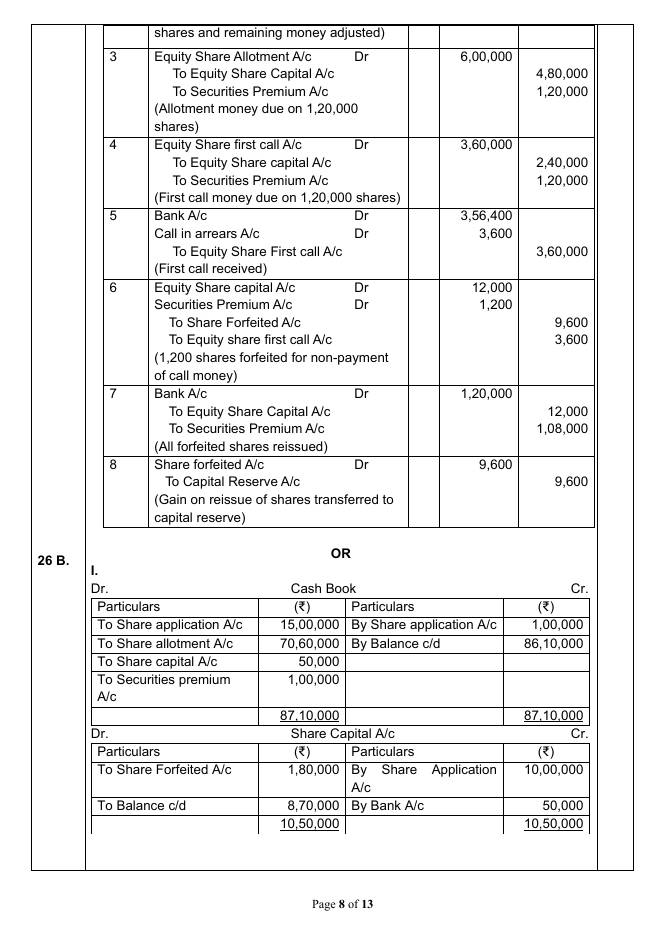
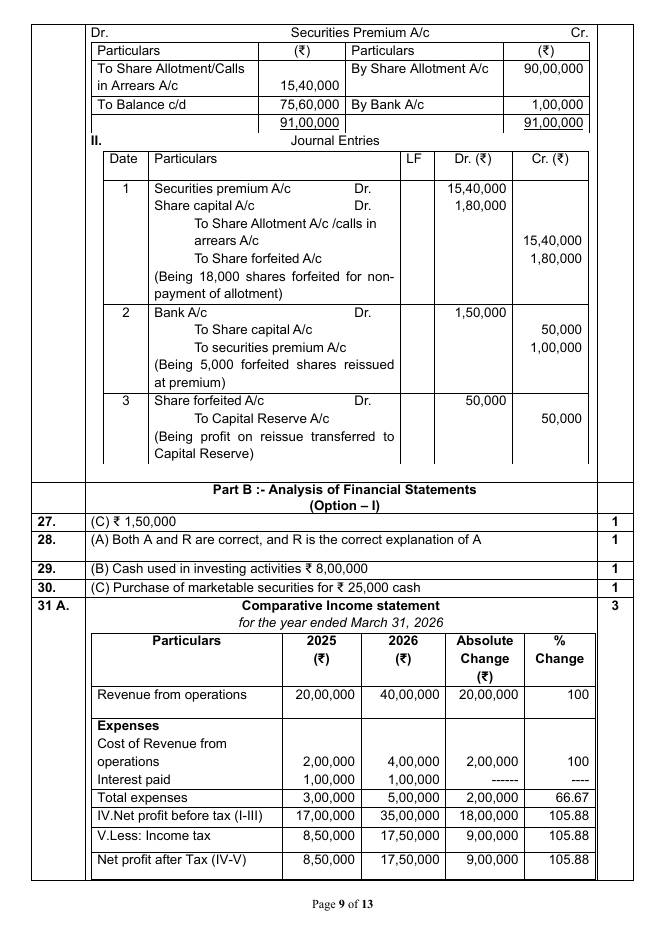
26 A. JOURNAL 6 Date Particulars LF Dr (₹) Cr (₹)Particulars L.F. Debit (₹) Credit (₹) 1 Bank A/c Dr. 16,20,000 To Equity Share Application A/c 16,20,000 (Application money received on 2,70,000 shares)Particulars L.F. Debit (₹) Credit (₹) 2 Equity Share application A/c Dr. 16,20,000 To Equity Share Capital A/c 4,80,000 To Bank A/c 3,00,000 To Equity Share Allotment A/c 6,00,000 To Securities Premium A/c 2,40,000 (Share application accepted on 1,20,000 shares and remaining money adjusted)Particulars L.F. Debit (₹) Credit (₹) 3 Equity Share Allotment A/c Dr. 6,00,000 To Equity Share Capital A/c 4,80,000 To Securities Premium A/c 1,20,000 (Allotment money due on 1,20,000 shares)Particulars L.F. Debit (₹) Credit (₹) 4 Equity Share first call A/c Dr. 3,60,000 To Equity Share capital A/c 2,40,000 To Securities Premium A/c 1,20,000 (First call money due on 1,20,000 shares)Particulars L.F. Debit (₹) Credit (₹) 5 Bank A/c Dr. 3,56,400 Call in arrears A/c Dr. 3,600 To Equity Share First call A/c 3,60,000 (First call received)Particulars L.F. Debit (₹) Credit (₹) 6 Equity Share capital A/c Dr. 12,000 Securities Premium A/c Dr. 1,200 To Share Forfeited A/c 9,600 To Equity share first call A/c 3,600 (1,200 shares forfeited for non-payment of call money)Particulars L.F. Debit (₹) Credit (₹) 7 Bank A/c Dr. 1,20,000 To Equity Share Capital A/c 12,000 To Securities Premium A/c 1,08,000 (All forfeited shares reissued)Particulars L.F. Debit (₹) Credit (₹) 8 Share forfeited A/c Dr. 9,600 To Capital Reserve A/c 9,600 (Gain on reissue of shares transferred to capital reserve) OR 26 B. I. Dr. Cash Book Cr. Particulars (₹) Particulars (₹) To Share application A/c 15,00,000 By Share application A/c 1,00,000 To Share allotment A/c 70,60,000 By Balance c/d 86,10,000 To Share capital A/c 50,000 To Securities premium 1,00,000 A/c 87,10,000 87,10,000 Dr. Share Capital A/c Cr. Particulars (₹) Particulars (₹) To Share Forfeited A/c 1,80,000 By Share Application 10,00,000 A/c To Balance c/d 8,70,000 By Bank A/c 50,000 10,50,000 10,50,000 Dr. Securities Premium A/c Cr. Particulars (₹) Particulars (₹) To Share Allotment/Calls By Share Allotment A/c 90,00,000 in Arrears A/c 15,40,000 To Balance c/d 75,60,000 By Bank A/c 1,00,000 91,00,000 91,00,000 II. Journal Entries Date Particulars LF Dr. (₹) Cr. (₹) 1 Securities premium A/c Dr. 15,40,000 Share capital A/c Dr. 1,80,000 To Share Allotment A/c /calls in arrears A/c 15,40,000 To Share forfeited A/c 1,80,000 (Being 18,000 shares forfeited for non- payment of allotment)Particulars L.F. Debit (₹) Credit (₹) 2 Bank A/c Dr. 1,50,000 To Share capital A/c 50,000 To securities premium A/c 1,00,000 (Being 5,000 forfeited shares reissued at premium)Particulars L.F. Debit (₹) Credit (₹) 3 Share forfeited A/c Dr. 50,000 To Capital Reserve A/c 50,000 (Being profit on reissue transferred to Capital Reserve)Independent verification noteQ26A: Applications accepted for 2,60,000 shares against 1,20,000 allotted give a pro-rata ratio of 13:6. Application receipts are ₹16,20,000. Rejected applications require ₹60,000 refund; accepted applicants have ₹8,40,000 excess application money, of which ₹6,00,000 covers allotment and ₹2,40,000 remains. The scheme's ₹3,00,000 total refund reconciles: ₹60,000 rejection refund plus ₹2,40,000 residual excess. Under that refund treatment, Parivesh owes the full ₹3,600 call. Forfeiture:Particulars L.F. Debit (₹) Credit (₹) Share Capital A/c Dr. 12,000 Securities Premium A/c Dr. 1,200 To Calls in Arrears A/c 3,600 To Share Forfeiture A/c 9,600 Reissue produces ₹9,600 Capital Reserve. The scheme incorrectly credits Share First Call on forfeiture after already transferring the arrears to Calls in Arrears. Alternatively, if the residual ₹2,40,000 is carried forward against calls, call receipts are Bank ₹1,18,800 plus Calls in Advance ₹2,40,000, with ₹1,200 arrears. Under proportional allocation of Parivesh's ₹2,400 advance between call capital and premium, unpaid premium is ₹800 and forfeiture/Capital Reserve is ₹11,600; those figures depend on that allocation assumption. Reissue under either treatment:Particulars L.F. Debit (₹) Credit (₹) Bank A/c Dr. 1,20,000 To Share Capital A/c 12,000 To Securities Premium A/c 1,08,000 Original pages for Question 26
 Motivation"I really think a champion is defined not by their wins but by how they can recover when they fall." : Serena Williams, TennisNow write it yourselfYou have read, listened and understood. Now close the answer, take a blank page and write and solve this question on your own, in proper CBSE format, with a timer running. Then check against the model answer. That effort will give you confidence for this type and similar types of questions.
- Question 271 mark
Part B Option I: Analysis of Financial Statements
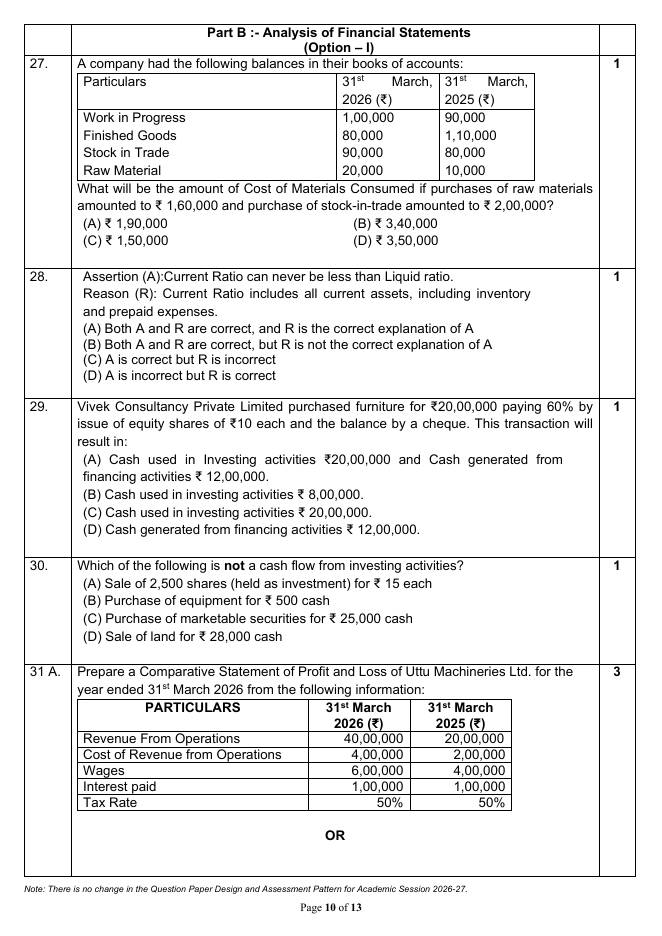
27.        A company had the following balances in their books of accounts:                                 1
             Particulars                                31st     March, 31st    March,
                                                        2026 (₹)         2025 (₹)
             Work in Progress                           1,00,000         90,000
             Finished Goods                             80,000           1,10,000
             Stock in Trade                             90,000           80,000
             Raw Material                               20,000           10,000
            What will be the amount of Cost of Materials Consumed if purchases of raw materials
            amounted to ₹ 1,60,000 and purchase of stock-in-trade amounted to ₹ 2,00,000?
             (A) ₹ 1,90,000                               (B) ₹ 3,40,000
             (C) ₹ 1,50,000                               (D) ₹ 3,50,000
Official CBSE answer and marking
27. (C) ₹ 1,50,000 1Original pages for Question 27
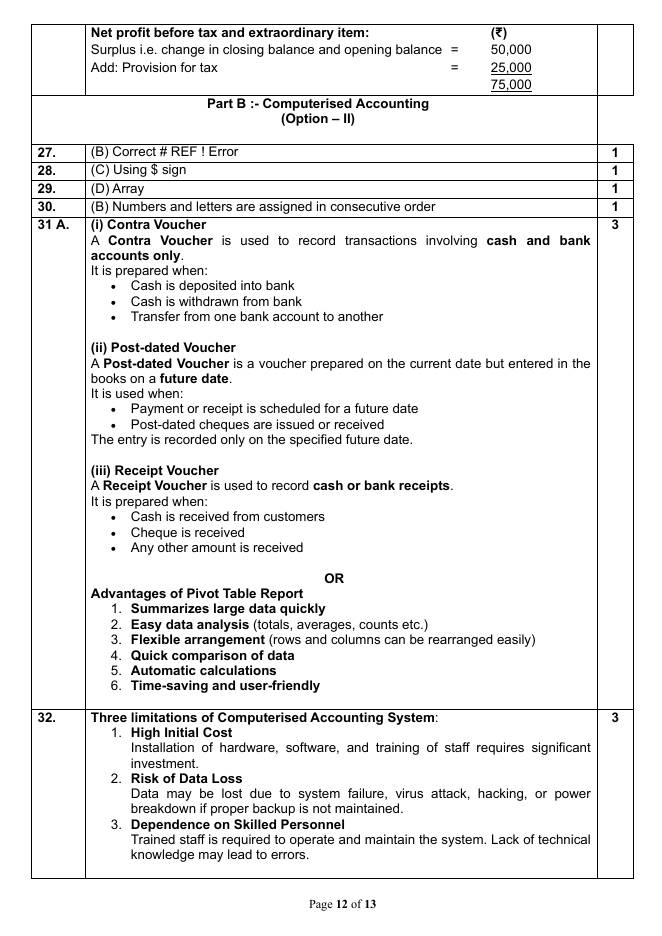
Part B Option II: Computerised Accounting
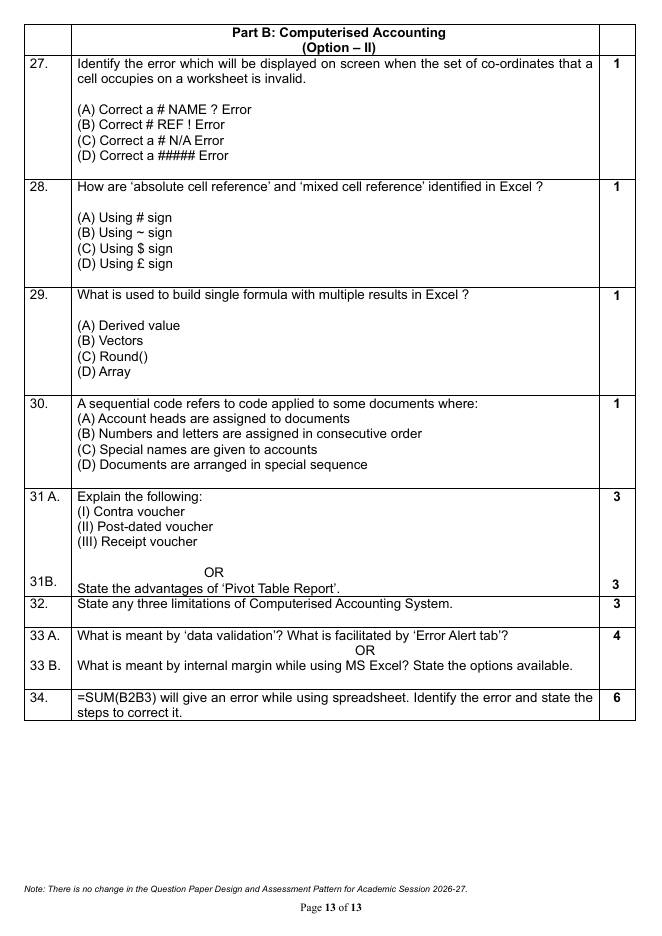
27.        Identify the error which will be displayed on screen when the set of co-ordinates that a         1
            cell occupies on a worksheet is invalid.
            (A) Correct a # NAME ? Error
            (B) Correct # REF ! Error
            (C) Correct a # N/A Error
            (D) Correct a ##### Error
Official CBSE answer and marking
27. (B) Correct # REF ! Error 1Original pages for Question 27 · Option II
 Motivation"There is no way around hard work. Embrace it." : Roger Federer, Tennis (attributed)Now write it yourselfYou have read, listened and understood. Now close the answer, take a blank page and write and solve this question on your own, in proper CBSE format, with a timer running. Then check against the model answer. That effort will give you confidence for this type and similar types of questions.
- Question 281 mark
Part B Option I: Analysis of Financial Statements
28.          Assertion (A):Current Ratio can never be less than Liquid ratio.                               1
              Reason (R): Current Ratio includes all current assets, including inventory
              and prepaid expenses.
              (A) Both A and R are correct, and R is the correct explanation of A
              (B) Both A and R are correct, but R is not the correct explanation of A
              (C) A is correct but R is incorrect
              (D) A is incorrect but R is correct
Official CBSE answer and marking
28. (A) Both A and R are correct, and R is the correct explanation of A 1Original pages for Question 28
Part B Option II: Computerised Accounting
28.        How are ‘absolute cell reference’ and ‘mixed cell reference’ identified in Excel ?               1
            (A) Using # sign
            (B) Using ~ sign
            (C) Using $ sign
            (D) Using £ sign
Official CBSE answer and marking
28. (C) Using $ sign 1Original pages for Question 28 · Option II
Motivation"Start where you are. Use what you have. Do what you can." : Arthur Ashe, TennisNow write it yourselfYou have read, listened and understood. Now close the answer, take a blank page and write and solve this question on your own, in proper CBSE format, with a timer running. Then check against the model answer. That effort will give you confidence for this type and similar types of questions. - Question 291 mark
Part B Option I: Analysis of Financial Statements
29.        Vivek Consultancy Private Limited purchased furniture for ₹20,00,000 paying 60% by               1
            issue of equity shares of ₹10 each and the balance by a cheque. This transaction will
            result in:
             (A) Cash used in Investing activities ₹20,00,000 and Cash generated from
             financing activities ₹ 12,00,000.
             (B) Cash used in investing activities ₹ 8,00,000.
             (C) Cash used in investing activities ₹ 20,00,000.
             (D) Cash generated from financing activities ₹ 12,00,000.
Official CBSE answer and marking
29. (B) Cash used in investing activities ₹ 8,00,000 1Original pages for Question 29
Part B Option II: Computerised Accounting
29.        What is used to build single formula with multiple results in Excel ?                            1
            (A) Derived value
            (B) Vectors
            (C) Round()
            (D) Array
Official CBSE answer and marking
29. (D) Array 1Original pages for Question 29 · Option II
Motivation"The moment of victory is much too short to live for that and nothing else." : Martina Navratilova, TennisNow write it yourselfYou have read, listened and understood. Now close the answer, take a blank page and write and solve this question on your own, in proper CBSE format, with a timer running. Then check against the model answer. That effort will give you confidence for this type and similar types of questions. - Question 301 mark
Part B Option I: Analysis of Financial Statements
30.        Which of the following is not a cash flow from investing activities?                             1
            (A) Sale of 2,500 shares (held as investment) for ₹ 15 each
            (B) Purchase of equipment for ₹ 500 cash
            (C) Purchase of marketable securities for ₹ 25,000 cash
            (D) Sale of land for ₹ 28,000 cash
Official CBSE answer and marking
30. (C) Purchase of marketable securities for ₹ 25,000 cash 1Independent verification noteOfficial option C assumes the marketable securities qualify as cash equivalents. Securities are not automatically cash equivalents; if the maturity, liquidity and value-risk conditions are not met, their purchase can be an investing cash flow.Original pages for Question 30
Part B Option II: Computerised Accounting
30.        A sequential code refers to code applied to some documents where:                                1
            (A) Account heads are assigned to documents
            (B) Numbers and letters are assigned in consecutive order
            (C) Special names are given to accounts
            (D) Documents are arranged in special sequence
Official CBSE answer and marking
30. (B) Numbers and letters are assigned in consecutive order 1Original pages for Question 30 · Option II
Motivation"Success is no accident. It is hard work, perseverance, learning, studying, sacrifice and most of all, love of what you are doing." : Pele, FootballNow write it yourselfYou have read, listened and understood. Now close the answer, take a blank page and write and solve this question on your own, in proper CBSE format, with a timer running. Then check against the model answer. That effort will give you confidence for this type and similar types of questions. - Question 313 marks
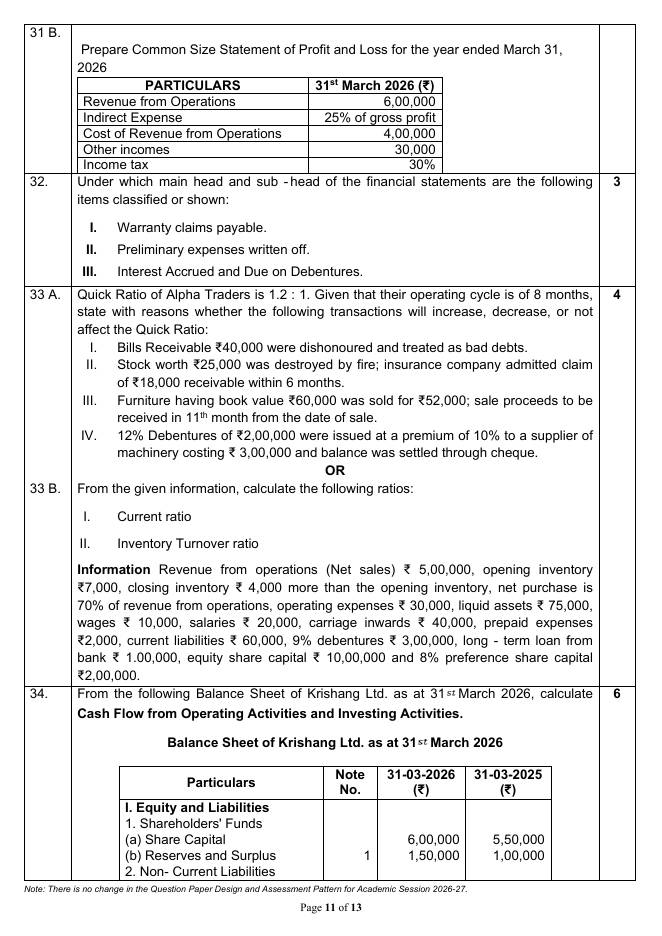
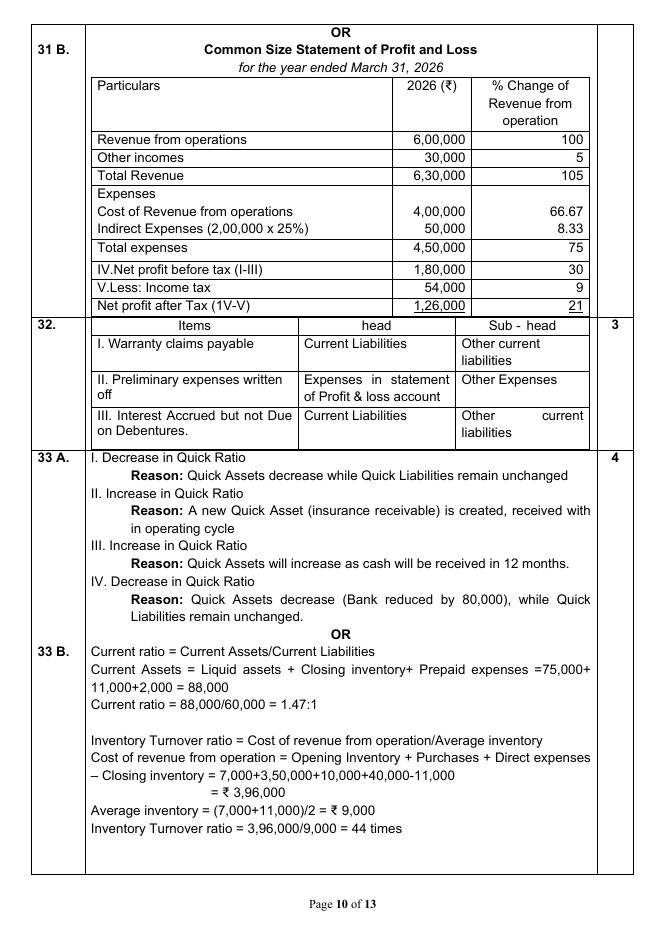
Part B Option I: Analysis of Financial Statements
31 A.      Prepare a Comparative Statement of Profit and Loss of Uttu Machineries Ltd. for the              3
            year ended 31st March 2026 from the following information:
                        PARTICULARS                  31st March        31st March
                                                      2026 (₹)          2025 (₹)
             Revenue From Operations                    40,00,000        20,00,000
             Cost of Revenue from Operations              4,00,000          2,00,000
             Wages                                        6,00,000          4,00,000
             Interest paid                                1,00,000          1,00,000
             Tax Rate                                         50%               50%
                                                                       OR
 31 B.
             Prepare Common Size Statement of Profit and Loss for the year ended March 31,
            2026
                         PARTICULARS            31st March 2026 (₹)
              Revenue from Operations                       6,00,000
              Indirect Expense                    25% of gross profit
              Cost of Revenue from Operations               4,00,000
              Other incomes                                    30,000
              Income tax                                          30%
Official CBSE answer and marking
31 A. Comparative Income statement 3 for the year ended March 31, 2026 Particulars 2025 2026 Absolute % (₹) (₹) Change Change (₹) Revenue from operations 20,00,000 40,00,000 20,00,000 100 Expenses Cost of Revenue from operations 2,00,000 4,00,000 2,00,000 100 Interest paid 1,00,000 1,00,000 ------ ---- Total expenses 3,00,000 5,00,000 2,00,000 66.67 IV.Net profit before tax (I-III) 17,00,000 35,00,000 18,00,000 105.88 V.Less: Income tax 8,50,000 17,50,000 9,00,000 105.88 Net profit after Tax (IV-V) 8,50,000 17,50,000 9,00,000 105.88 OR 31 B. Common Size Statement of Profit and Loss for the year ended March 31, 2026 Particulars 2026 (₹) % Change of Revenue from operation Revenue from operations 6,00,000 100 Other incomes 30,000 5 Total Revenue 6,30,000 105 Expenses Cost of Revenue from operations 4,00,000 66.67 Indirect Expenses (2,00,000 x 25%) 50,000 8.33 Total expenses 4,50,000 75 IV.Net profit before tax (I-III) 1,80,000 30 V.Less: Income tax 54,000 9 Net profit after Tax (1V-V) 1,26,000 21Original pages for Question 31
Part B Option II: Computerised Accounting
31 A.      Explain the following:                                                                           3
            (I) Contra voucher
            (II) Post-dated voucher
            (III) Receipt voucher
                                  OR
 31B.       State the advantages of ‘Pivot Table Report’.                                                    3
Official CBSE answer and marking
31 A. (i) Contra Voucher 3 A Contra Voucher is used to record transactions involving cash and bank accounts only. It is prepared when: • Cash is deposited into bank • Cash is withdrawn from bank • Transfer from one bank account to another (ii) Post-dated Voucher A Post-dated Voucher is a voucher prepared on the current date but entered in the books on a future date. It is used when: • Payment or receipt is scheduled for a future date • Post-dated cheques are issued or received The entry is recorded only on the specified future date. (iii) Receipt Voucher A Receipt Voucher is used to record cash or bank receipts. It is prepared when: • Cash is received from customers • Cheque is received • Any other amount is received OR Advantages of Pivot Table Report 1. Summarizes large data quickly 2. Easy data analysis (totals, averages, counts etc.) 3. Flexible arrangement (rows and columns can be rearranged easily) 4. Quick comparison of data 5. Automatic calculations 6. Time-saving and user-friendlyOriginal pages for Question 31 · Option II
Motivation"Talent without working hard is nothing." : Cristiano Ronaldo, FootballNow write it yourselfYou have read, listened and understood. Now close the answer, take a blank page and write and solve this question on your own, in proper CBSE format, with a timer running. Then check against the model answer. That effort will give you confidence for this type and similar types of questions. - Question 323 marks
Part B Option I: Analysis of Financial Statements
32.        Under which main head and sub - head of the financial statements are the following                            3
            items classified or shown:
               I.     Warranty claims payable.
              II.     Preliminary expenses written off.
             III.     Interest Accrued and Due on Debentures.
Official CBSE answer and marking
32. Items head Sub - head 3 I. Warranty claims payable Current Liabilities Other current liabilities II. Preliminary expenses written Expenses in statement Other Expenses off of Profit & loss account III. Interest Accrued but not Due Current Liabilities Other current on Debentures. liabilitiesIndependent verification noteQ32(iii) says interest accrued and due, not the scheme's accrued but not due. Preserve the printed wording. Classification remains Current Liabilities, Other Current Liabilities.Original pages for Question 32
Part B Option II: Computerised Accounting
32. State any three limitations of Computerised Accounting System. 3
Official CBSE answer and marking
32. Three limitations of Computerised Accounting System: 3 1. High Initial Cost Installation of hardware, software, and training of staff requires significant investment. 2. Risk of Data Loss Data may be lost due to system failure, virus attack, hacking, or power breakdown if proper backup is not maintained. 3. Dependence on Skilled Personnel Trained staff is required to operate and maintain the system. Lack of technical knowledge may lead to errors.Original pages for Question 32 · Option II
Motivation"You have to fight to reach your dream. You have to sacrifice and work hard for it." : Lionel Messi, Football (attributed)Now write it yourselfYou have read, listened and understood. Now close the answer, take a blank page and write and solve this question on your own, in proper CBSE format, with a timer running. Then check against the model answer. That effort will give you confidence for this type and similar types of questions. - Question 334 marks
Part B Option I: Analysis of Financial Statements
33 A.      Quick Ratio of Alpha Traders is 1.2 : 1. Given that their operating cycle is of 8 months,                     4
            state with reasons whether the following transactions will increase, decrease, or not
            affect the Quick Ratio:
               I. Bills Receivable ₹40,000 were dishonoured and treated as bad debts.
              II. Stock worth ₹25,000 was destroyed by fire; insurance company admitted claim
                    of ₹18,000 receivable within 6 months.
             III. Furniture having book value ₹60,000 was sold for ₹52,000; sale proceeds to be
                    received in 11th month from the date of sale.
             IV. 12% Debentures of ₹2,00,000 were issued at a premium of 10% to a supplier of
                    machinery costing ₹ 3,00,000 and balance was settled through cheque.
                                                       OR
 33 B.      From the given information, calculate the following ratios:
              I.      Current ratio
             II.      Inventory Turnover ratio
            Information Revenue from operations (Net sales) ₹ 5,00,000, opening inventory
            ₹7,000, closing inventory ₹ 4,000 more than the opening inventory, net purchase is
            70% of revenue from operations, operating expenses ₹ 30,000, liquid assets ₹ 75,000,
            wages ₹ 10,000, salaries ₹ 20,000, carriage inwards ₹ 40,000, prepaid expenses
            ₹2,000, current liabilities ₹ 60,000, 9% debentures ₹ 3,00,000, long - term loan from
            bank ₹ 1.00,000, equity share capital ₹ 10,00,000 and 8% preference share capital
            ₹2,00,000.
Official CBSE answer and marking
33 A. I. Decrease in Quick Ratio 4 Reason: Quick Assets decrease while Quick Liabilities remain unchanged II. Increase in Quick Ratio Reason: A new Quick Asset (insurance receivable) is created, received with in operating cycle III. Increase in Quick Ratio Reason: Quick Assets will increase as cash will be received in 12 months. IV. Decrease in Quick Ratio Reason: Quick Assets decrease (Bank reduced by 80,000), while Quick Liabilities remain unchanged. OR 33 B. Current ratio = Current Assets/Current Liabilities Current Assets = Liquid assets + Closing inventory+ Prepaid expenses =75,000+ 11,000+2,000 = 88,000 Current ratio = 88,000/60,000 = 1.47:1 Inventory Turnover ratio = Cost of revenue from operation/Average inventory Cost of revenue from operation = Opening Inventory + Purchases + Direct expenses - Closing inventory = 7,000+3,50,000+10,000+40,000-11,000 = ₹ 3,96,000 Average inventory = (7,000+11,000)/2 = ₹ 9,000 Inventory Turnover ratio = 3,96,000/9,000 = 44 timesIndependent verification noteFor Q33A(iii), the amount is receivable in the 11th month, hence within 12 months. It is not stated to have already been received. Its current-asset treatment supports the increase in quick ratio.Original pages for Question 33
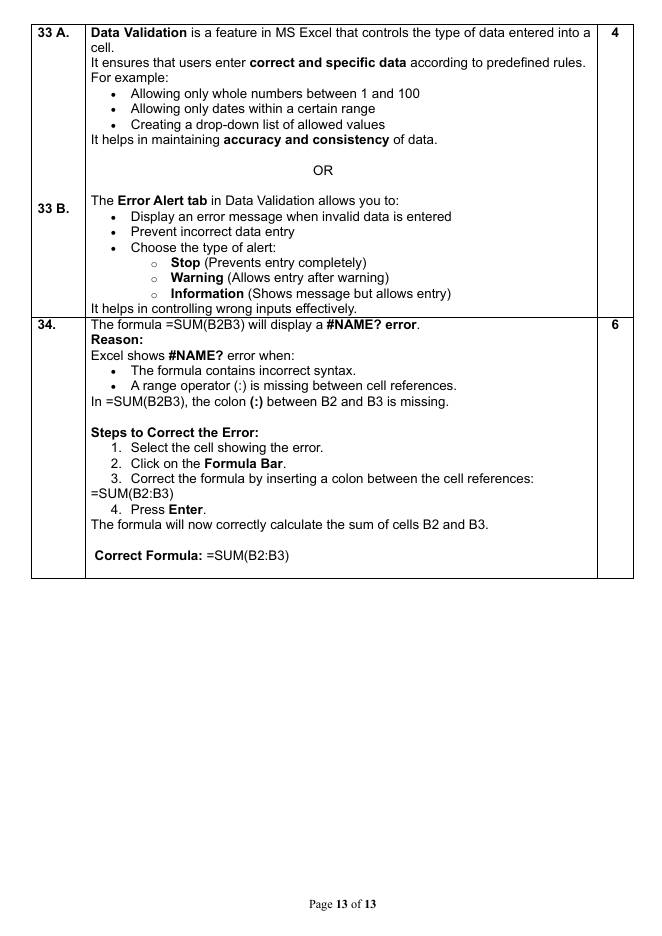
Part B Option II: Computerised Accounting
33 A.      What is meant by ‘data validation’? What is facilitated by ‘Error Alert tab’?                    4
                                                            OR
 33 B.      What is meant by internal margin while using MS Excel? State the options available.
Official CBSE answer and marking
33 A. Data Validation is a feature in MS Excel that controls the type of data entered into a 4 cell. It ensures that users enter correct and specific data according to predefined rules. For example: • Allowing only whole numbers between 1 and 100 • Allowing only dates within a certain range • Creating a drop-down list of allowed values It helps in maintaining accuracy and consistency of data. OR The Error Alert tab in Data Validation allows you to: 33 B. • Display an error message when invalid data is entered • Prevent incorrect data entry • Choose the type of alert: o Stop (Prevents entry completely) o Warning (Allows entry after warning) o Information (Shows message but allows entry) It helps in controlling wrong inputs effectively.Independent verification noteThe official alternative labels are mismatched: Error Alert belongs to Q33A, and no internal-margin answer is supplied for Q33B. Independent answer for Q33A: Error Alert specifies whether invalid input produces an alert, its Stop/Warning/Information style and its title/message. Stop blocks invalid entry; Warning and Information allow acceptance through confirmation. Independent answer for Q33B: Internal margin is the space between a text box or shape boundary and its text. Available settings are Left, Right, Top and Bottom. These are text-box/shape controls, not ordinary worksheet-cell padding.Original pages for Question 33 · Option II
 Motivation"The vision of a champion is someone who is bent over, drenched in sweat, at the point of exhaustion, when no one else is watching." : Mia Hamm, FootballNow write it yourselfYou have read, listened and understood. Now close the answer, take a blank page and write and solve this question on your own, in proper CBSE format, with a timer running. Then check against the model answer. That effort will give you confidence for this type and similar types of questions.
- Question 346 marks
Part B Option I: Analysis of Financial Statements
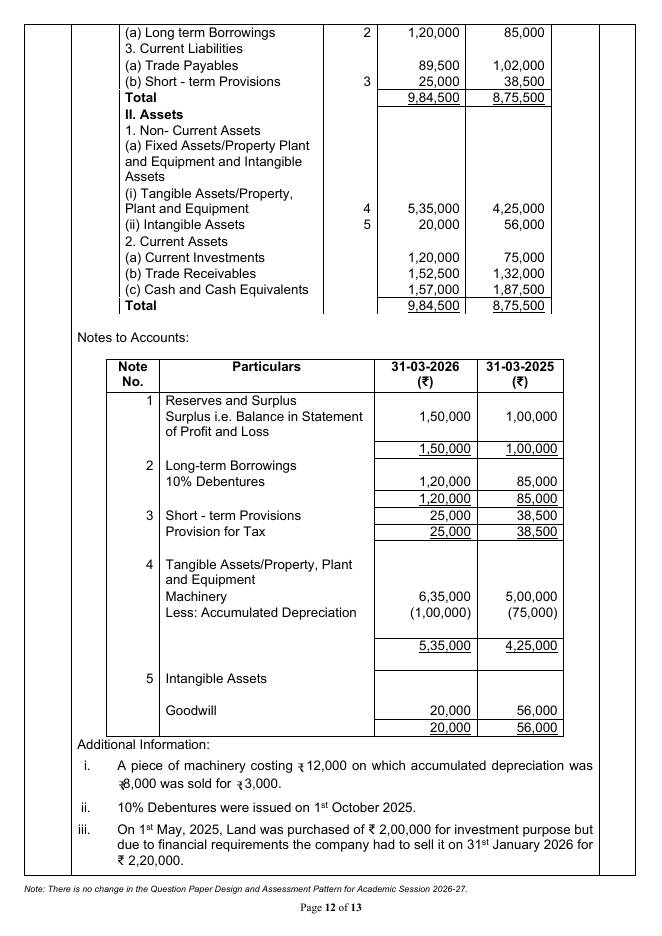
34.        From the following Balance Sheet of Krishang Ltd. as at 31 March 2026, calculate                              6
            Cash Flow from Operating Activities and Investing Activities.
                                  Balance Sheet of Krishang Ltd. as at 31 March 2026
                                                                          Note        31-03-2026             31-03-2025
                                      Particulars
                                                                          No.             (₹)                    (₹)
                        I. Equity and Liabilities
                        1. Shareholders' Funds
                        (a) Share Capital                                                  6,00,000            5,50,000
                        (b) Reserves and Surplus                                  1        1,50,000            1,00,000
                        2. Non- Current Liabilities
                        (a) Long term Borrowings                                  2        1,20,000            85,000
                        3. Current Liabilities
                        (a) Trade Payables                                                   89,500          1,02,000
                        (b) Short - term Provisions                               3          25,000            38,500
                        Total                                                              9,84,500          8,75,500
                        II. Assets
                        1. Non- Current Assets
                        (a) Fixed Assets/Property Plant
                        and Equipment and Intangible
                        Assets
                        (i) Tangible Assets/Property,
                        Plant and Equipment                                       4        5,35,000          4,25,000
                        (ii) Intangible Assets                                    5          20,000            56,000
                        2. Current Assets
                        (a) Current Investments                                            1,20,000            75,000
                        (b) Trade Receivables                                              1,52,500          1,32,000
                        (c) Cash and Cash Equivalents                                      1,57,000          1,87,500
                        Total                                                              9,84,500          8,75,500
            Notes to Accounts:
                      Note              Particulars                                    31-03-2026            31-03-2025
                      No.                                                                  (₹)                   (₹)
                          1 Reserves and Surplus
                            Surplus i.e. Balance in Statement                                 1,50,000         1,00,000
                            of Profit and Loss
                                                                                              1,50,000         1,00,000
                             2 Long-term Borrowings
                               10% Debentures                                                 1,20,000           85,000
                                                                                              1,20,000           85,000
                             3 Short - term Provisions                                          25,000           38,500
                               Provision for Tax                                                25,000           38,500
                             4 Tangible Assets/Property, Plant
                               and Equipment
                               Machinery                                                      6,35,000         5,00,000
                               Less: Accumulated Depreciation                               (1,00,000)         (75,000)
                                                                                              5,35,000         4,25,000
                             5 Intangible Assets
                                 Goodwill                                                        20,000          56,000
                                                                                                 20,000          56,000
            Additional Information:
              i.      A piece of machinery costing 12,000 on which accumulated depreciation was
                       8,000 was sold for 3,000.
             ii.      10% Debentures were issued on 1st October 2025.
            iii.      On 1st May, 2025, Land was purchased of ₹ 2,00,000 for investment purpose but
                      due to financial requirements the company had to sell it on 31st January 2026 for
                      ₹ 2,20,000.
Official CBSE answer and marking
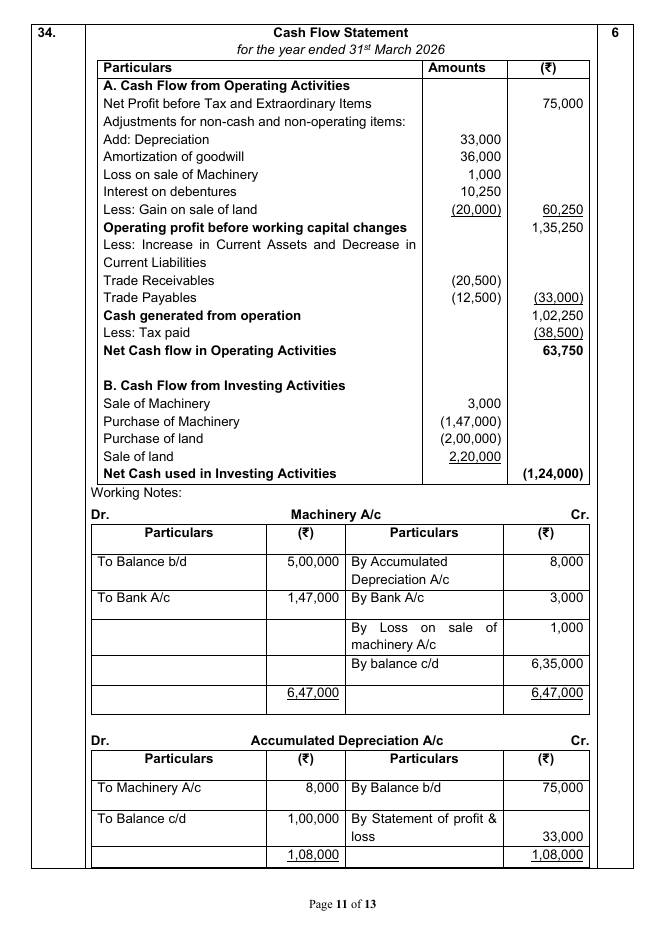
34. Cash Flow Statement 6 for the year ended 31st March 2026 Particulars Amounts (₹) A. Cash Flow from Operating Activities Net Profit before Tax and Extraordinary Items 75,000 Adjustments for non-cash and non-operating items: Add: Depreciation 33,000 Amortization of goodwill 36,000 Loss on sale of Machinery 1,000 Interest on debentures 10,250 Less: Gain on sale of land (20,000) 60,250 Operating profit before working capital changes 1,35,250 Less: Increase in Current Assets and Decrease in Current Liabilities Trade Receivables (20,500) Trade Payables (12,500) (33,000) Cash generated from operation 1,02,250 Less: Tax paid (38,500) Net Cash flow in Operating Activities 63,750 B. Cash Flow from Investing Activities Sale of Machinery 3,000 Purchase of Machinery (1,47,000) Purchase of land (2,00,000) Sale of land 2,20,000 Net Cash used in Investing Activities (1,24,000) Working Notes: Dr. Machinery A/c Cr. Particulars (₹) Particulars (₹) To Balance b/d 5,00,000 By Accumulated 8,000 Depreciation A/c To Bank A/c 1,47,000 By Bank A/c 3,000 By Loss on sale of 1,000 machinery A/c By balance c/d 6,35,000 6,47,000 6,47,000 Dr. Accumulated Depreciation A/c Cr. Particulars (₹) Particulars (₹) To Machinery A/c 8,000 By Balance b/d 75,000 To Balance c/d 1,00,000 By Statement of profit & loss 33,000 1,08,000 1,08,000 Net profit before tax and extraordinary item: (₹) Surplus i.e. change in closing balance and opening balance = 50,000 Add: Provision for tax = 25,000 75,000Original pages for Question 34
Part B Option II: Computerised Accounting
34.        =SUM(B2B3) will give an error while using spreadsheet. Identify the error and state the          6
            steps to correct it.
Official CBSE answer and marking
34. The formula =SUM(B2B3) will display a #NAME? error. 6 Reason: Excel shows #NAME? error when: • The formula contains incorrect syntax. • A range operator (:) is missing between cell references. In =SUM(B2B3), the colon (:) between B2 and B3 is missing. Steps to Correct the Error: 1. Select the cell showing the error. 2. Click on the Formula Bar. 3. Correct the formula by inserting a colon between the cell references: =SUM(B2:B3) 4. Press Enter. The formula will now correctly calculate the sum of cells B2 and B3. Correct Formula: =SUM(B2:B3)Original pages for Question 34 · Option II
Motivation"It is hard to beat a person who never gives up." : Babe Ruth, BaseballNow write it yourselfYou have read, listened and understood. Now close the answer, take a blank page and write and solve this question on your own, in proper CBSE format, with a timer running. Then check against the model answer. That effort will give you confidence for this type and similar types of questions.
Original CBSE pages (question paper and marking scheme)